



Содержание
Перейти к:
https://doi.org/10.30895/10.30895/2312-7821-2026-14-2-184-194
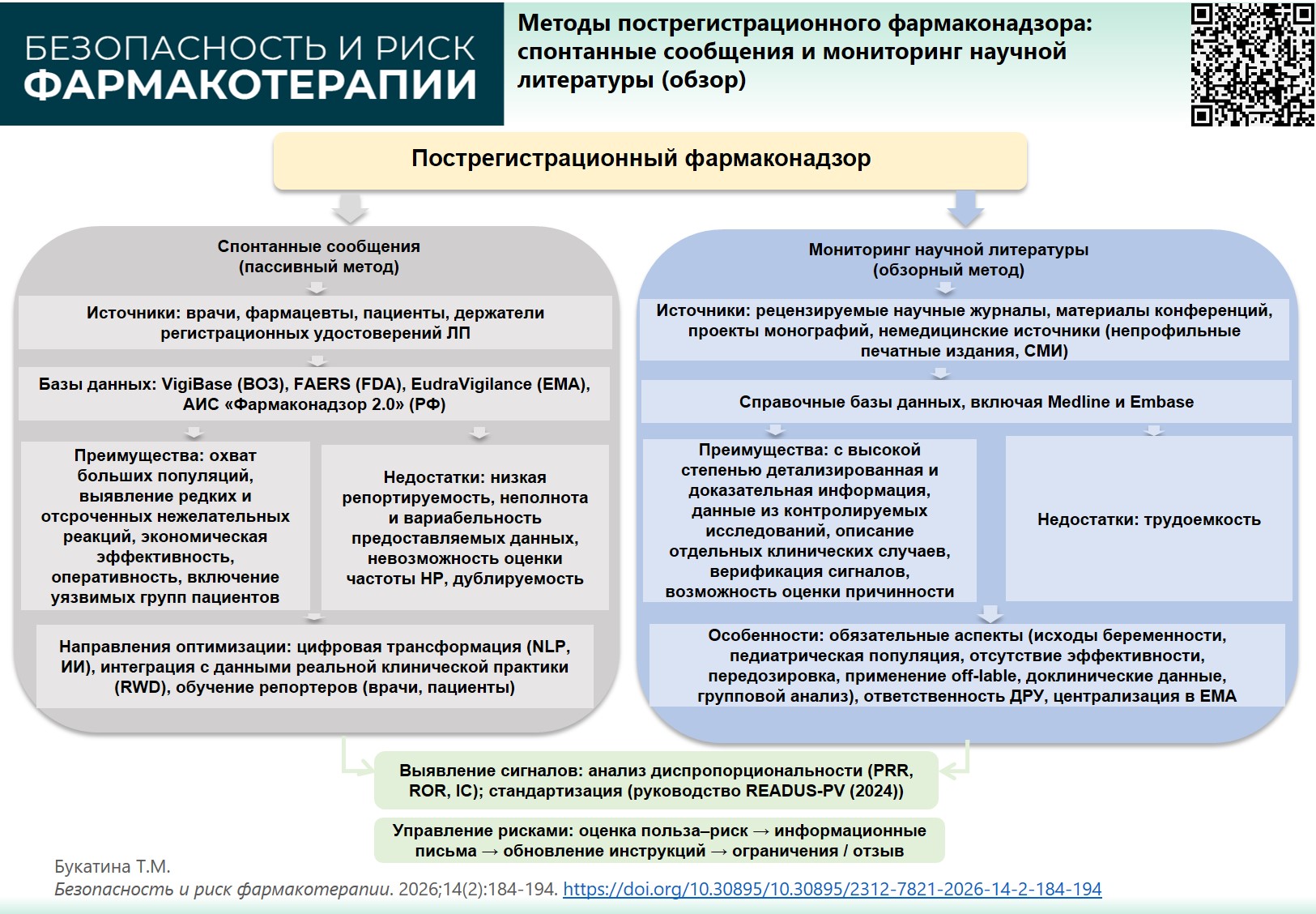
Перейти к:
ВВЕДЕНИЕ. Многие аспекты профиля безопасности лекарственных препаратов (ЛП), включая редкие и отсроченные нежелательные реакции (НР), выявляются только в пострегистрационном периоде при применении в реальной клинической практике. Однако недостатки, характерные для основных методов пострегистрационного фармаконадзора — спонтанного репортирования и мониторинга научной литературы, такие как неполнота, фрагментарность, вариабельность качества данных, а также отсутствие единых подходов к их анализу, обусловливают необходимость систематизации информации и унификации подходов к обработке данных.
ЦЕЛЬ. Систематизация информации о методах спонтанных сообщений и мониторинга научной литературы, а также о подходах к обработке данных в пострегистрационном фармаконадзоре для управления рисками и обеспечения безопасности лекарственных препаратов.
ОБСУЖДЕНИЕ. Спонтанное репортирование — базовый пассивный метод пострегистрационного мониторинга безопасности ЛП, преимуществами которого являются большой охват населения и возможность выявления широкого спектра НР, включая редкие, отсроченные и ранее неизвестные. Повысить эффективность метода спонтанных сообщений позволит разработка образовательных программ для медицинских работников и пациентов, внедрение технологий обработки естественного языка (natural language processing, NLP), позволяющее автоматизировать извлечение структурированной информации о НР из неструктурированных текстовых источников, а также интеграция с данными реальной клинической практики (real-world data, RWD) для подтверждения сигналов и количественной оценки рисков. Мониторинг научной литературы является связующим звеном между пассивным сбором RWD и научно обоснованными доказательствами, полученными в контролируемых исследованиях. Анализ Правил надлежащей практики фармаконадзора ЕАЭС показал, что при поиске информации в научной литературе необходимо принимать во внимание особые аспекты профиля безопасности ЛП: влияние на исходы беременности, применение в педиатрии, отсутствие эффективности, передозировка, несоответствующее общей характеристике ЛП применение, доклинические данные. Для стандартизации статистических методов выявления сигналов и их корректной интерпретации (анализ диспропорциональности в массивах спонтанных сообщений) рекомендуется использовать руководство READUS-PV (2024 г.).
ВЫВОДЫ. Современная методология пострегистрационного фармаконадзора является динамично развивающейся системой. Представленная систематизация подходов к спонтанным сообщениям и мониторингу научной литературы, а также перечень обязательных аспектов безопасности ЛП могут служить практическим инструментом для специалистов при планировании и проведении оценки безопасности ЛП.
Букатина Т.М. Методы пострегистрационного фармаконадзора: спонтанные сообщения и мониторинг научной литературы (обзор). Безопасность и риск фармакотерапии. 2026;14(2):184-194. https://doi.org/10.30895/10.30895/2312-7821-2026-14-2-184-194
Bukatina T.M. Post-marketing pharmacovigilance methods: Spontaneous reports and scientifi c literature monitoring (review). Safety and Risk of Pharmacotherapy. 2026;14(2):184-194. (In Russ.) https://doi.org/10.30895/10.30895/2312-7821-2026-14-2-184-194
Клинические исследования лекарственных препаратов (ЛП) характеризуются методологическими ограничениями: малый объем выборки, ограниченная продолжительность наблюдения и исключение уязвимых групп пациентов (детей, беременных женщин, лиц пожилого возраста с коморбидной патологией) [1–4]. Многие аспекты профиля безопасности ЛП, включая редкие, очень редкие, отсроченные нежелательные реакции (НР), а также НР, возникающие при длительном применении, и НР, обусловленные лекарственными взаимодействиями, выявляются только в пострегистрационном периоде по мере накопления данных в широкой клинической практике [3–7]. В связи с этим для своевременного выявления НР необходима эффективная система фармаконадзора, основанная на непрерывном мониторинге и анализе данных о безопасности1 [8].
Вместе с тем существующая система пострегистрационного фармаконадзора имеет ряд методологических ограничений. Для спонтанного репортирования, являющегося основным источником данных о безопасности ЛП, типичны низкая частота сообщений, неполнота и вариабельность предоставляемой информации [9][10]. Мониторинг научной литературы, который держатели регистрационных удостоверений (ДРУ) осуществляют автономно, нередко методологически разобщен с процессом обработки спонтанных сообщений. Отсутствуют единые подходы к анализу данных из спонтанных сообщений и научной литературы, статистические методы выявления сигналов безопасности в массивах спонтанных сообщений недостаточно унифицированы, а перспективные технологии (обработка естественного языка, данные реальной клинической практики) используются ограниченно [11][12]. Кроме того, отсутствуют единые принципы проведения эффективного мониторинга специфических аспектов безопасности ЛП, таких как влияние на исходы беременности, передозировка, отсутствие эффективности, а также применение в педиатрии и гериатрии [13]. Указанные факторы определяют актуальность систематизации информации о методе спонтанных сообщений и мониторинге научной литературы.
Цель работы — систематизация информации о методах спонтанных сообщений и мониторинга научной литературы, а также о подходах к обработке данных в пострегистрационном фармаконадзоре для управления рисками и обеспечения безопасности лекарственных препаратов.
Проведен информационно-аналитический поиск в открытых источниках, включая базы данных научной литературы eLIBRARY.RU, PubMed, КиберЛенинка, Cochrane Library, поисковой системе Google Scholar, а также на официальных сайтах регуляторных органов. Ключевые слова для поиска: пострегистрационное наблюдение / postmarketing surveillance; методы фармаконадзора / pharmacovigilance methods; signal detection / обнаружение сигналов; спонтанное репортирование / spontaneous reporting; источники данных по безопасности лекарственных средств / drug safety data sources; управление рисками / risk management. Критерии включения: публикации по методологии пострегистрационного фармаконадзора, сравнительные исследования, систематические обзоры, руководства регуляторных органов. Ограничений по глубине поиска не устанавливали. После удаления дублирующих научных публикаций для анализа отобрана 81 работа.
Мониторинг безопасности ЛП в пострегистрационном периоде представляет собой многоуровневую систему методов, направленных на выявление, оценку и предотвращение развития НР. Основная цель — своевременное обнаружение изменений профиля безопасности ЛП, влияющих на соотношение «польза–риск»2 [14][15].
Основным документом, определяющим требования к организации мониторинга безопасности ЛП на территории Евразийского экономического союза (ЕАЭС), являются Правила надлежащей практики фармаконадзора ЕАЭС, утвержденные Решением Совета ЕЭК от 03.11.2016 № 873 (далее — Правила НПФ). В данном документе описаны процедуры и методы сбора, анализа и оценки информации о безопасности ЛП, обязательные для всех субъектов обращения ЛП в государствах — членах ЕАЭС. В соответствии с Правилами НПФ мониторинг безопасности ЛП отнесен к категории критических процессов пострегистрационного фармаконадзора. Невыполнение либо ненадлежащее выполнение установленных требований является основанием для применения мер регуляторного воздействия вплоть до отзыва ЛП из обращения. На национальном уровне регулирование дополняется Федеральным законом от 12.04.2010 № 61-ФЗ «Об обращении лекарственных средств» (ст. 64), а также приказом Росздравнадзора от 17.06.2024 № 3518 «Об утверждении Порядка фармаконадзора лекарственных препаратов для медицинского применения», который детализирует процедуры сбора, обработки и анализа информации о безопасности ЛП в Российской Федерации.
Метод спонтанных сообщений представляет собой пассивный метод сбора информации о безопасности ЛП, основанный на добровольном информировании о подозреваемых НР. Данный метод является основополагающим компонентом пострегистрационного фармаконадзора и наиболее распространенным инструментом выявления редких и ранее неизвестных НР в пострегистрационном периоде, поскольку позволяет охватить миллионы пациентов в условиях реальной клинической практики [16][17].
Источниками спонтанных сообщений являются медицинские работники, пациенты или их представители, ДРУ, а также интернет-ресурсы. Для признания сообщения валидным достаточно наличия четырех обязательных элементов: идентификация репортера, пациента, подозреваемого ЛП и описание симптомов НР [14]. Важно отметить, что полнота и качество информации в спонтанных сообщениях существенно варьируют и зависят от источника сообщения. В то же время, согласно результатам исследования D. Dubrall и соавт. (2025), сообщения от потребителей (пациентов) по полноте структурированной информации сопоставимы с сообщениями от врачей и фармацевтов, что подтверждает их ценность для фармаконадзора и отражает глобальную тенденцию к пациент-ориентированному подходу [18].
Накопление спонтанных сообщений осуществляется в специализированных базах данных. В Российской Федерации передача всех сообщений о НР производится через автоматизированную информационную систему Росздравнадзора «Фармаконадзор 2.0»4. На международном уровне основными базами данных являются VigiBase Всемирной организации здравоохранения [19], EudraVigilance Европейского агентства по лекарственным средствам (European Medicines Agency, ЕМА) [20] и FAERS Управления по контролю за качеством продуктов питания и лекарственных средств (Food and Drug Administration, FDA) [21]. Важной особенностью международных баз является различие в источниках поступления данных. VigiBase получает сообщения только от национальных центров фармаконадзора, EudraVigilance и FAERS аккумулируют также данные от ДРУ и содержит сведения о НР, выявленных в ходе клинических исследований. Обмен информацией между странами обеспечивает быстрое выявление сигналов безопасности, повышая вероятность обнаружения редких и отсроченных НР, которые могут остаться незамеченными при анализе данных для отдельно взятой страны [17].
Обработка спонтанного сообщения включает следующие этапы5: 1) первичный прием и регистрация; 2) кодирование терминов по медицинскому словарю для регуляторной деятельности MedDRA (Medical Dictionary for Regulatory Activities) [22]; 3) валидацию; 4) оценку серьезности и предвиденности; 5) оценку причинно-следственной связи; 6) направление в регуляторные органы в установленные сроки (15 календарных дней — для серьезных НР за исключением случаев, требующих незамедлительного реагирования). Для НР, повлекших смерть пациента или угрожающих жизни, установлен сокращенный срок направления — 3 рабочих дня.
Метод спонтанных сообщений служит основой для выявления сигналов по безопасности ЛП. К массивам сообщений применяются статистические методы анализа диспропорциональности: отношение пропорциональных сообщений (proportional reporting ratio, PRR), отношение шансов сообщений (reporting odds ratio, ROR), информационный компонент (information component, IC), основанный на байесовском подходе. Обнаружение сигналов обязательно дополняется клинической оценкой [10][23]. Важно отметить, что методология анализа диспропорциональности до недавнего времени не была стандартизирована, что приводило к вариабельности результатов и затрудняло их интерпретацию. В 2024 г. международной группой экспертов было разработано и опубликовано руководство READUS-PV (REporting of A Disproportionality analysis for drUg Safety signal detection using individual case safety reports in PharmacoVigilance), содержащее 14 основных и 4 дополнительных пункта рекомендаций по отчетности для анализа диспропорциональности. Применение этих рекомендаций призвано обеспечить прозрачность, полноту и точность отчетности, а также правильную интерпретацию результатов, что в конечном итоге будет способствовать принятию обоснованных решений в фармаконадзоре [24][25].
На основании выявленных сигналов регуляторные органы могут инициировать меры воздействия. Спектр таких мер широк и включает не только отзыв ЛП из обращения, но и, например, внесение изменений в инструкцию по медицинскому применению, ограничение показаний к применению, выпуск информационных писем для медицинских работников, а также инициирование дополнительных пострегистрационных исследований6.
Преимуществами метода спонтанных сообщений являются: охват больших популяций в условиях реальной клинической практики; возможность выявления редких и очень редких НР; экономическая эффективность; оперативность получения сигналов о новых проблемах по безопасности; включение уязвимых групп пациентов [5][16][17]. Ограничения метода заключаются в низкой репортируемости (по разным оценкам регистрируется только 5–10% всех НР); неполноте информации; невозможности оценки истинной частоты НР; систематическом смещении в сторону серьезных НР; дублировании сообщений; вариабельности качества данных [5][18][26–29].
Ключевые направления совершенствования. Первое направление — повышение частоты репортирования и качества сообщений через образовательные программы для медицинских работников и пациентов [30][31]. Вторым направлением является внедрение цифровых инструментов и технологий искусственного интеллекта для автоматизации обработки сообщений и выявления сигналов [32][33]. Применение методов обработки естественного языка (natural language processing, NLP) позволяет автоматизировать извлечение структурированной информации о НР из неструктурированных текстовых источников, включая текстовые описания в спонтанных сообщениях, электронных медицинских картах и данных из социальных интернет-ресурсов. Внедрение NLP-инструментов значительно повышает эффективность выявления НР и сокращает временны́е затраты на обработку данных [34][35]. Третье направление для совершенствования спонтанного репортирования — разработка гибридных подходов, сочетающих спонтанные сообщения с данными реальной клинической практики (real-world data, RWD), электронных медицинских карт, регистров и страховых баз для подтверждения сигналов и количественной оценки рисков [36][37].
Регулярный мониторинг научной литературы, как и анализ спонтанных сообщений, является важным источником информации о безопасности ЛП. Данный метод занимает особое место в структуре фармаконадзора, выступая связующим звеном между пассивным сбором данных из реальной клинической практики и научно обоснованными доказательствами, полученными в контролируемых исследованиях7 [38]. В рамках этого метода осуществляется систематический поиск и анализ описаний НР, представленных в научных публикациях. Объектами анализа выступают отдельные описания клинических случаев, серии случаев, а также результаты наблюдательных и клинических исследований, в которых зарегистрированы НР, связанные с применением ЛП [39]. Данный метод позволяет аккумулировать информацию, которая зачастую не попадает в официальные базы спонтанных сообщений, но обладает высокой степенью детализации и доказательности.
Согласно регуляторным требованиям Правил НПФ, научная медицинская литература признается важным источником информации для мониторинга профиля безопасности и соотношения «польза–риск» ЛП, особенно в отношении обнаружения новых сигналов, связанных с безопасностью. Правила НПФ (п. 394) предписывают ДРУ осуществлять систематический обзор научной медицинской литературы с периодичностью не реже одного раза в неделю [14]. Поиск должен проводиться в широко используемых справочных базах данных, включая Medline и Embase, с обеспечением максимального охвата ссылок на статьи, имеющие отношение к мониторируемому ЛП [40].
Правилами НПФ (п. 636) определено, что в отчетных документах (периодических обновляемых отчетах по безопасности, планах управления рисками) должна быть представлена обобщенная информация о новых и значимых данных по безопасности, опубликованных в рецензируемой научной медицинской литературе. При этом поиск информации должен включать не только индивидуальные сообщения о НР, но и исследования, в которых оценивались исходы НР в группах субъектов. Данные о подозреваемых НР, публикуемые в научной медицинской литературе, включая материалы конференций и проекты монографий, необходимо выявлять и регистрировать как спонтанные сообщения или сообщения, выявленные в ходе неинтервенционных пострегистрационных исследований (Правила НПФ, п. 395). Дополнительно указано, что информацию из немедицинских источников (непрофильные печатные издания, средства массовой информации) следует обрабатывать по тем же правилам, что и спонтанные сообщения, с проработкой случая с целью получения минимально необходимой информации (Правила НПФ, п. 398).
При мониторинге научной литературы необходимо уделять особое внимание ряду аспектов профиля безопасности лекарственных препаратов (Правила НПФ, п. 638). Данные аспекты подлежат обязательному мониторингу и должны отражаться в периодических обновляемых отчетах по безопасности и планах управления рисками (табл. 1).
Таблица 1. Обязательные для мониторинга аспекты безопасности лекарственных препаратов при анализе научной литературы (в соответствии с Решением Совета ЕЭК № 87 от 03.11.2016, п. 638)
Table 1. Mandatory safety aspects of medicinal products for monitoring during analysis of scientific literature (Eurasian Economic Commission Council Decision No. 87 dated November 03, 2016, clause 638)
Категория Category | Характеристика Characteristic | Примеры Examples | Источник Source |
Исходы беременности Pregnancy outcomes | Исходы беременности, включая случаи прерывания беременности, в том числе не сопровождавшиеся нежелательными реакциями у матери или плода Pregnancy outcomes, including cases of pregnancy termination, including those not accompanied by adverse drug reactions in the mother or fetus | Самопроизвольные аборты. Медицинские аборты после воздействия лекарственного препарата. Врожденные аномалии. Осложнения беременности (гестационный диабет, преэклампсия) Spontaneous abortions. Medical abortions following exposure to the medicinal product. Congenital anomalies. Pregnancy complications (gestational diabetes, preeclampsia) | [41–47] |
Применение лекарственного препарата в педиатрической популяции Use of medicinal product in the pediatric population | Любые сообщения о применении препарата у детей, включая случаи в рамках клинических исследований и пострегистрационного применения Any reports of medicinal product use in children, including cases from clinical trials and post-marketing use | Возрастные группы (новорожденные, грудные дети, дети до 18 лет). Особенности дозирования. Специфические педиатрические нежелательные реакции Age groups (newborns, infants, children up to 18 years). Dosing specifics. Specific pediatric adverse drug reactions | [48–53] |
Программы применения Expanded access and personalized use programs | Назначение в связи с исключительными обстоятельствами из соображений сострадания, программы расширенного доступа, персонализированные программы применения Prescribing due to exceptional circumstances on compassionate grounds, expanded access programs, personalized use programs | Применение до регистрации для пациентов с угрожающими жизни состояниями. Программы именного доступа Pre-authorization use for patients with life-threatening conditions. Named patient programs | [54–58] |
Отсутствие эффективности Lack of efficacy | Документированные случаи отсутствия терапевтического эффекта лекарственного препарата Documented cases of absence of therapeutic effect of the medicinal product | Отсутствие ответа на терапию. Развитие резистентности. Неэффективность в реальной клинической практике Lack of response to therapy. Development of resistance. Lack of efficacy in real-world clinical practice | [59–64] |
Передозировка Overdose | В том числе симптоматическая передозировка, не приведшая к развитию нежелательных реакций Including symptomatic overdose not resulting in adverse drug reactions | Случайное превышение дозы. Суицидальные попытки. Ошибки при расчете дозы Accidental overdose. Suicide attempts. Dose calculation errors | [65–69] |
Несоответствующее / неправильное применение Inappropriate / incorrect use | Применение не по утвержденным показаниям (off-label), ошибки применения, включая случаи без развития нежелательной реакции Use not in accordance with approved indications (off-label), medication errors, including cases without adverse drug reaction development | Применение в непоказанных возрастных группах. Неправильный путь введения. Ошибки при разведении/при расчете дозы. Назначение без учета взаимодействий Use in unapproved age groups. Incorrect route of administration. Errors in dilution and dose calculation. Prescribing without considering interactions | [31][70–72] |
Доклинические данные Preclinical data | Значимые результаты доклинических исследований (токсикологических, фармакологических) Significant results from preclinical studies (toxicological, pharmacological) | Новые данные о токсичности в исследованиях на животных. Фармакокинетические взаимодействия. Генотоксичность, канцерогенность New toxicity data from animal studies. Pharmacokinetic interactions. Genotoxicity, carcinogenicity | [73–75] |
Групповой анализ Class-level analysis | Информация о безопасности других активных веществ лекарственного препарата, относящихся к той же фармакологической группе, включая данные о групповых эффектах Safety information on other active substances of medicinal products belonging to the same pharmacological class, including data on class effects | Класс-специфические нежелательные реакции / сравнительный анализ профиля безопасности внутри класса. Перекрестные аллергические реакции Class-specific adverse drug reactions / comparative analysis of the safety profile within the class. Allergic cross-reactivity | [76–79] |
Таблица составлена автором / The table was prepared by the author
Основное назначение мониторинга научной литературы заключается в верификации сигналов, первоначально выявленных на основании спонтанных сообщений. Однако в реальной практике анализ литературы и обработка спонтанных сообщений часто проводятся разобщенно, что снижает полноту оценки сигналов [12]. Описания отдельных случаев в рецензируемых журналах, как правило, содержат более детальную клиническую информацию, включая данные о временно́й связи НР с применением ЛП, результатах отмены и повторного назначения ЛП, а также о сопутствующих заболеваниях и терапии, что позволяет провести углубленную оценку причинно-следственной связи [14][39]. Кроме того, анализ научной литературы позволяет обнаруживать НР, выявленные в ходе контролируемых клинических исследований, которые могут не отражаться в системах спонтанных сообщений ввиду особенностей протоколов и ограниченного доступа к первичным данным [39].
Для обработки и анализа научных публикаций применяются различные подходы. Контент-анализ позволяет систематизировать описания НР по типам реакций, группам ЛП, характеристикам пациентов и другим значимым признакам8 [80]. Систематические обзоры единичных клинических случаев объединяют разрозненные описания для выявления общих закономерностей, оценки частоты встречаемости редких НР и анализа факторов риска [39]. В последние годы для обработки текстов научных статей все активнее применяются методы NLP и интеллектуального анализа текстов, автоматизирующие извлечение структурированной информации из неструктурированных текстовых описаний [80][81]. Эти технологии повышают скорость и полноту анализа больших массивов литературы.
Специфика мониторинга научной литературы обусловлена сочетанием двух методологических подходов: анализ отдельных клинических случаев сопоставим с оценкой спонтанных сообщений, тогда как интеграция данных контролируемых исследований существенно повышает доказательную значимость получаемых выводов. Таким образом, данный метод служит связующим звеном между пассивным фармаконадзором и научно обоснованными данными, позволяя интегрировать результаты пострегистрационных наблюдений в общую систему оценки профиля безопасности ЛП. Показано, что большинство сигналов о НР подтверждается результатами анализа клинических описаний случаев, опубликованных в научной литературе, с использованием критериев временной связи и результатов отмены и повторного назначения ЛП [39].
В международной практике наблюдаются тенденции к централизации мониторинга литературы: например ЕМА осуществляет централизованный мониторинг безопасности определенного перечня активных веществ, что позволяет избежать дублирования усилий ДРУ и повысить качество и единообразие отчетных данных9. В ЕАЭС ответственность за мониторинг литературы полностью возложена на ДРУ с обязательным документированием поисковой стратегии и результатов10.
Проведенный анализ позволил подтвердить, что метод спонтанных сообщений остается базовым инструментом выявления редких и отсроченных НР в реальной клинической практике, однако ему присущи ограничения: низкая репортируемость, неполнота и вариабельность качества данных. Повышение эффективности метода спонтанных сообщений может быть достигнуто обучением медицинских работников и пациентов, внедрением методов NLP для обработки данных, а также интеграцией данных спонтанного репортирования с данными реальной клинической практики (RWD).
Мониторинг научной литературы служит для верификации сигналов безопасности и интеграции научно обоснованных данных, при этом регуляторные требования ЕАЭС (Правила НПФ, п. 638) предписывают обязательный перечень аспектов безопасности ЛП для отслеживания при анализе литературы. Методологическая разобщенность между анализом литературы и спонтанными сообщениями остается актуальной проблемой, требующей разработки интегративных подходов.
Унификация статистических методов анализа диспропорциональности для выявления сигналов безопасности, несмотря на разработку руководства READUS-PV, остается неполной, что ограничивает сопоставимость получаемых данных. Дальнейшая гармонизация требований в рамках ЕАЭС будет способствовать повышению качества оценки безопасности ЛП.
Перспективным направлением является разработка гибридных подходов, сочетающих анализ различных источников данных (спонтанные сообщения, научная литература, электронные медицинские карты и др.) с применением технологий искусственного интеллекта для автоматизированного выявления и оценки рисков.
Таким образом, современная методология пострегистрационного мониторинга безопасности ЛП представляет собой динамично развивающуюся систему, требующую дальнейшей систематизации и унификации подходов для эффективного управления рисками и обеспечения благоприятного соотношения «польза–риск» на протяжении всего жизненного цикла ЛП.
Вклад авторов. Автор подтверждает соответствие своего авторства критериям ICMJE.
Использование генеративного искусственного интеллекта. Автор заявляет, что не использовал генеративный ИИ при подготовке рукописи.
Author contributions. The author confirms that she meets the ICMJE criteria for authorship.
Use of generative artificial intelligence. The author declares that no generative AI was used in preparing this manuscript.
1. Решение Совета ЕЭК от 03.11.2016 № 87 «Об утверждении Правил надлежащей практики фармаконадзора Евразийского экономического союза».
2. Там же.
3. Решение Совета ЕЭК от 03.11.2016 № 87 «Об утверждении Правил надлежащей практики фармаконадзора Евразийского экономического союза».
4. Приказ Росздравнадзора от 17.06.2024 № 3518 «Об утверждении Порядка фармаконадзора лекарственных препаратов для медицинского применения».
5. Решение Совета ЕЭК от 03.11.2016 № 87 «Об утверждении Правил надлежащей практики фармаконадзора Евразийского экономического союза».
6. Решение Совета ЕЭК от 03.11.2016 № 87 «Об утверждении Правил надлежащей практики фармаконадзора Евразийского экономического союза».
7. Medical literature monitoring. European Medicines Agency. https://www.ema.europa.eu/en/human-regulatory-overview/post-authorisation/pharmacovigilance-post-authorisation/medical-literature-monitoring
8. Решение Совета ЕЭК от 03.11.2016 № 87 «Об утверждении Правил надлежащей практики фармаконадзора Евразийского экономического союза».
9. European Medicines Agency. Medical literature monitoring. https://www.ema.europa.eu/en/human-regulatory-overview/post-authorisation/pharmacovigilance-post-authorisation/medical-literature-monitoring
10. Решение Совета ЕЭК от 03.11.2016 № 87 «Об утверждении Правил надлежащей практики фармаконадзора Евразийского экономического союза».
1. Журавлева МВ, Сереброва СЮ, Кузнецова ЕВ и др. Совершенствование системы фармаконадзора в медицинских организациях как возможность повышения качества фармакотерапии. Безопасность и риск фармакотерапии. 2025;13(1):94–107. https://doi.org/10.30895/2312-7821-2025-13-1-94-107
2. Pitkala KH, Strandberg TE. Clinical trials in older people. Age ¬Ageing. 2022;51(5):afab282. https://doi.org/10.1093/ageing/afab282
3. Alomar M, Tawfiq AM, Hassan N, et al. Post marketing surveillance of suspected adverse drug reactions through spontaneous reporting: current status, challenges and the future. Ther Adv Drug Saf. 2020;11:2042098620938595. https://doi.org/10.1177/2042098620938595
4. Raj N, Fernandes S, Charyulu NR, et al. Postmarket surveillance: A review on key aspects and measures on the effective functioning in the context of the United Kingdom and Canada. Ther Adv Drug Saf. 2019;10:2042098619865413. https://doi.org/10.1177/2042098619865413
5. Wasiullah M, Yadav P, Yadav SK, Yadav AK. Protecting health — A pharmacovigilance analysis of drug safety. Int J Pharm Res Appl. 2025;10(2):2377–83. https://doi.org/10.35629/4494-100223772383
6. Yu X, Zhong J, Lin Z, et al. Post-marketing safety concerns with trofinetide: A disproportionality analysis of the first therapeutic agent for Rett syndrome based on the FDA adverse event reporting system (FAERS). Front Pharmacol. 2026;17:1643906. https://doi.org/10.3389/fphar.2026.1643906
7. Abedian Kalkhoran H, Zwaveling J, van Hunsel F, et al. An innovative method to strengthen evidence for potential drug safety signals using electronic health records. J Med Syst. 2024;48(1):51. https://doi.org/10.1007/s10916-024-02070-2
8. Paul AE, Sasidharanpillai S. Role of pharmacovigilance in drug safety monitoring. Indian Dermatol Online J. 2025;16(4):545–50. https://doi.org/10.4103/idoj.idoj_771_24
9. Desai M. Pharmacovigilance and spontaneous adverse drug reaction reporting: Challenges and opportunities. Perspect Clin Res. 2022;13(4):177–9. https://doi.org/10.4103/picr.picr_169_22
10. Dedefo MG, Kassie GM, Gebreyohannes EA, et al. Completeness of spontaneously reported adverse drug reactions in 4 databases. Br J Clin Pharmacol. 2025;91(12):3389–400. https://doi.org/10.1002/bcp.70182
11. Hammad TA, Naylor M, Ely DM, et al. Exploring the complexities of disproportionality analysis in pharmacovigilance: Reflections on the READUS-PV guideline and a call to action. Front Pharmacol. 2025;16:1573353. https://doi.org/10.3389/fphar.2025.1573353
12. Бондарева ИБ, Зырянов СК, Асецкая ИЛ и др. Некоторые особенности статистического анализа данных спонтанных сообщений о нежелательных лекарственных реакциях. Качественная клиническая практика. 2024;(3):40–54. https://doi.org/10.37489/2588-0519-2024-3-40-54
13. Li Y, Wu Y, Jiang T, et al. Opportunities and challenges of pharmacovigilance in special populations: A narrative review of the literature. Ther Adv Drug Saf. 2023;14:20420986231200746. https://doi.org/10.1177/20420986231200746
14. Мильчаков КС. Рекомендации по мониторингу информации о безопасности и эффективности лекарственных препаратов в Российской Федерации в контексте фармаконадзора. Безопасность и риск фармакотерапии. 2022;10(3):218–29. https://doi.org/10.30895/2312-7821-2022-10-3-218-229
15. Шубникова ЕВ. Пострегистрационный фармаконадзор: обзор открытых источников получения данных по безопасности лекарственных препаратов. Безопасность и риск фармакотерапии. 2024;12(3):309–30. https://doi.org/10.30895/2312-7821-2024-12-3-309-330
16. Литвиненко ТС, Сафроненко АВ, Макляков ЮС и др. Анализ спонтанных сообщений как «инструмент» фармаконадзора. Биомедицина. 2022;18(2):40–5. https://doi.org/10.33647/2074-5982-18-2-40-45
17. Казаков АС, Дармостукова МА, Букатина ТМ и др. Сравнительный анализ международных баз данных спонтанных сообщений о нежелательных реакциях лекарственных средств. Безопасность и риск фармакотерапии. 2020;8(3):134–40. https://doi.org/10.30895/2312-7821-2020-8-3-134-140
18. Dubrall D, Christ P, Domgörgen S, et al. Factors associated with the completeness of information provided in adverse drug reaction reports of physicians, pharmacists and consumers from Germany. Sci Rep. 2025;15(1):23751. https://doi.org/10.1038/s41598-025-07973-9
19. Brand JS, Gauffin O, Sartori D, et al. VigiBase: Resource profile update with a summary of global patterns and trends in adverse event reports for medicines and vaccines. Drug Saf. 2026;49:613–29. https://doi.org/10.1007/s40264-025-01642-6
20. Postigo R, Brosch S, Slattery J, et al. EudraVigilance medicines safety database: Publicly accessible data for research and public health protection. Drug Saf. 2018;41(7):665–75. https://doi.org/10.1007/s40264-018-0647-1
21. Potter E, Reyes M, Naples J, et al. FDA Adverse Event Reporting System (FAERS) essentials: A guide to understanding, applying, and interpreting adverse event data reported to FAERS. Clin Pharmacol Ther. 2025;118(3):567–82. https://doi.org/10.1002/cpt.3701
22. Combi C, Zorzi M, Pozzani G, et al. From narrative descriptions to MedDRA: Automagically encoding adverse drug reactions. J Biomed Inform. 2018;84:184–99. https://doi.org/10.1016/j.jbi.2018.07.001
23. Jiao XF, Pu L, Lan S, et al. Adverse drug reaction signal detection methods in spontaneous reporting system: A systematic review. Pharmacoepidemiol Drug Saf. 2024;33(3):e5768. https://doi.org/10.1002/pds.5768
24. Fusaroli M, Salvo F, Begaud B, et al. The reporting of a disproportionality analysis for drug safety signal detection using individual case safety reports in pharmacovigilance (READUS-PV): Development and statement. Drug Saf. 2024;47(6):575–84. https://doi.org/10.1007/s40264-024-01421-9
25. Fusaroli M, Salvo F, Begaud B, et al. The reporting of a disproportionality analysis for drug safety signal detection using individual case safety reports in pharmacovigilance (READUS-PV): Explanation and elaboration. Drug Saf. 2024;47(6):585–99. https://doi.org/10.1007/s40264-024-01423-7
26. Graeff V, Wehler M, Dormann H, et al. Comparative analysis of drugs frequently suspected of causing adverse drug reactions reported via the spontaneous reporting system versus in a prospective multicentre cohort study in hospital emergency departments. J Clin Med. 2025;14(17):5921. https://doi.org/10.3390/jcm14175921
27. Noguchi Y, Tachi T, Yoshimura T. Is it appropriate to conduct a disproportionality analysis using a spontaneous reporting database to investigate whether drug-related adverse events are dose-dependent? Front Pharmacol. 2025;16:1563524. https://doi.org/10.3389/fphar.2025.1563524
28. Kiguba R, Isabirye G, Mayengo J, et al. Navigating duplication in pharmacovigilance databases: A scoping review. BMJ Open. 2024;14(4):e081990. https://doi.org/10.1136/bmjopen-2023-081990
29. Lavertu A, Vora B, Giacomini KM, et al. A new era in pharmacovigilance: Toward real-world data and digital monitoring. Clin Pharmacol Ther. 2021;109(5):1197–202. https://doi.org/10.1002/cpt.2172
30. Mugoša S, Meštrović A, Vukićević V, et al. SMART Pharmacist — The impact of education on improving pharmacists’ participation in monitoring the safety of medicine use in Montenegro. Pharmacy (Basel). 2025;13(2):57. https://doi.org/10.3390/pharmacy13020057
31. Saad AH, Bondok R, Sayeg F, et al. Enhancing medication error reporting through interprofessional education: Analysis of Medwatch reporting accuracy and completion rates between teams and individuals. BMC Med Educ. 2025;25(1):756. https://doi.org/10.1186/s12909-025-07349-7
32. Crisafulli S, Bate A, Brown JS, et al. Interplay of spontaneous reporting and longitudinal healthcare databases for signal management: Position statement from the real-world evidence and big data Special Interest Group of the International Society of Pharmacovigilance. Drug Saf. 2025;48(9):959–76. https://doi.org/10.1007/s40264-025-01548-3
33. Warner J, Prada Jardim A, Albera C, et al. Artificial intelligence: Applications in pharmacovigilance signal management. Pharmaceut Med. 2025;39(3):183–98. https://doi.org/10.1007/s40290-025-00561-2
34. van der Weg W, von Kreijfelt G, Davidson L, et al. Strengthening spontaneous reporting-based signal detection during a pandemic with cases from electronic health records using a natural language processing tool. Vaccine. 2025;62:127549. https://doi.org/10.1016/j.vaccine.2025.127549
35. Khemani DB, Malave DS, Shinde S, et al. AI-driven pharmacovigilance: Enhancing adverse drug reaction detection with deep learning and NLP. MethodsX. 2025;15:103460. https://doi.org/10.1016/j.mex.2025.103460
36. Sharma R. Recent advances in pharmacovigilance: Artificial intelligence, real world evidence, and global harmonization. Int J Sci Res. 2025;14(2):1123–8. https://doi.org/10.21275/SR251226122226
37. Hu Q, Li J, Li X, et al. Machine learning to predict adverse drug events based on electronic health records: A systematic review and meta-analysis. J Int Med Res. 2024;52(12):3000605241302304. https://doi.org/10.1177/03000605241302304
38. Malikova MA. Practical applications of regulatory requirements for signal detection and communications in pharmacovigilance. Ther Adv Drug Saf. 2020;11:2042098620909614. https://doi.org/10.1177/2042098620909614
39. Sartori D, Aronson JK, Norén GN, et al. Signals of adverse drug reactions communicated by pharmacovigilance stakeholders: A scoping review of the global literature. Drug Saf. 2023;46(2):109–20. https://doi.org/10.1007/s40264-022-01258-0
40. Матвеев АВ, Крашенинников АЕ, Матвеева ЕА, и др. Различия европейских и евразийских правил надлежащей практики фармаконадзора. Безопасность и риск фармакотерапии. 2021;9(2):75–84. https://doi.org/10.30895/2312-7821-2021-9-2-75-84
41. Shafi J, Virk MK, Kalk E, et al. Pharmacovigilance in pregnancy studies, exposures and outcomes ascertainment, and findings from low-and middle-income countries: A scoping review. Drug Saf. 2024;47(10):957–90. https://doi.org/10.1007/s40264-024-01445-1
42. Abadie D, Hurault-Delarue C, Damase-Michel C, et al. Medication exposure and spontaneous abortion: A case-control study using a French medical database. Clin Exp Obstet Gynecol. 2015;42(4):431–6. PMID: 26411206
43. Kelesidou V, Tsakiridis I, Virgiliou A, et al. Combination of mifepristone and misoprostol for first-trimester medical abortion: A comprehensive review of the literature. Obstet Gynecol Surv. 2024;79(1):54–63. https://doi.org/10.1097/ogx.0000000000001222
44. Leichombam R, Bawiskar D. Exploring the safety and efficacy of medical termination of pregnancy: A comprehensive review. Cureus. 2023;15(10):e46444. https://doi.org/10.7759/cureus.46444
45. Dubucs C, Plaisancié J, Courtade-Saidi M, et al. The first review on prenatal drug exposure and ocular malformation occurrence. Front Pediatr. 2024;12:1379875. https://doi.org/10.3389/fped.2024.1379875
46. Wang T, Jiang R, Yao Y, et al. Anti-hypertensive therapy for preeclampsia: A network meta-analysis and systematic review. ¬Hypertens Pregnancy. 2024;43(1):2329068. https://doi.org/10.1080/10641955.2024.2329068
47. Akre S, Sharma K, Chakole S, et al. Eclampsia and its treatment modalities: A review article. Cureus. 2022;14(9):e29080. https://doi.org/10.7759/cureus.29080
48. Lu H, Rosenbaum S. Developmental pharmacokinetics in pediatric populations. J Pediatr Pharmacol Ther. 2014;19(4):262–76. https://doi.org/10.5863/1551-6776-19.4.262
49. Гавриленко ЛН. Актуальная проблема в педиатрии: особенности применения «детских» и «взрослых» форм лекарственных препаратов у детей. Рецепт. 2024;27(3):481–7. https://doi.org/10.34883/PI.2024.27.3.014
50. Wong IC, Ghaleb MA, Franklin BD, Barber N. Incidence and nature of dosing errors in paediatric medications: A systematic review. Drug Saf. 2004;27(9):661–70. https://doi.org/10.2165/00002018-200427090-00004
51. Meesters K, Balbas-Martinez V, Allegaert K, et al. Personalized dosing of medicines for children: A primer on pediatric pharmacometrics for clinicians. Paediatr Drugs. 2024;26(4):365–79. https://doi.org/10.1007/s40272-024-00633-x
52. Бутранова ОИ, Кустов ЮО, Зырянов СК, и др. Профиль безопасности ципрофлоксацина в педиатрической популяции: анализ базы данных спонтанных сообщений. Качественная клиническая практика. 2025;(4):55–64. https://doi.org/10.37489/2588-0519-GCP-0005
53. Sultana S, Mitu FH. Pharmacovigilance in paediatric population: An evolving landscape in drug safety monitoring. Mugda Medical College Journal. 2025;8(2):150–6. https://doi.org/10.3329/mumcj.v8i2.85830
54. Rosenberg N, Post HC, Schutte T, et al. Access to anticancer and orphan medicines through compassionate use programs and named patient basis in seven European countries. ESMO Open. 2025;10(11):105855. https://doi.org/10.1016/j.esmoop.2025.105855
55. Polak TB, Cucchi DGJ, van Rosmalen J, et al. Generating evidence from expanded access use of rare disease medicines: Challenges and recommendations. Front Pharmacol. 2022;13:913567. https://doi.org/10.3389/fphar.2022.913567
56. Polak TB, van Rosmalen J, Uyl-de Groot CA. Expanded access as a source of real-world data: An overview of FDA and EMA approvals. Br J Clin Pharmacol. 2020;86(9):1819–26. https://doi.org/10.1111/bcp.14284
57. Vermeulen SF, Polak TB, Bunnik EM. Expanded access to investigational drugs in psychiatry: A systematic review. Psychiatry Res. 2023;329:115554. https://doi.org/10.1016/j.psychres.2023.115554
58. Polak TB, Cucchi DGJ, Schelhaas J, et al. Results from expanded access programs: A review of academic literature. Drugs. 2023;83(9):795–805. https://doi.org/10.1007/s40265-023-01879-4
59. Marsal J, Barreiro-de Acosta M, Blumenstein I, et al. Management of non-response and loss of response to anti-tumor necrosis factor therapy in inflammatory bowel disease. Front Med (Lausanne). 2022;9:897936. https://doi.org/10.3389/fmed.2022.897936
60. Hirschfeld RM, Montgomery SA, Aguglia E, et al. Partial response and nonresponse to antidepressant therapy: Current approaches and treatment options. J Clin Psychiatry. 2002;63(9):826–37. https://doi.org/10.4088/jcp.v63n0913
61. Gajdács M, Albericio F. Antibiotic resistance: From the bench to patients. Antibiotics (Basel). 2019;8(3):129. https://doi.org/10.3390/antibiotics8030129
62. Ахмадходжаева ММ. Современные стратегии преодоления антибиотикорезистентности. Медицинский журнал молодых ученых. 2025;16(12):190–7.
63. Balew M, Abeje G, Mekonnen A, et al. Prevalence of HIV drug resistance among patients experiencing first-line treatment failure in Ethiopia: A systematic review and meta-analysis. BMC Public Health. 2025;25(1):2059. https://doi.org/10.1186/s12889-025-23193-2
64. Жукова ОВ, Чеснокова НН, Воробьева ОА и др. Неэффективность карбапенемов в реальной клинической практике по данным терапевтического лекарственного мониторинга и сообщениям АИС Росздравнадзора. Качественная клиническая практика. 2024;(2):66–71. https://doi.org/10.37489/2588-0519-2024-2-65-71
65. Gaikwad V, Kumbhar S, Chougule N. Pharmacovigilance and over counter drugs ensuring safety. Int J Pharm. Sci. 2024;2(12):1193–212. https://doi.org/10.5281/zenodo.14361696
66. Murshed M, Salim M, Boyd BJ. Existing and emerging mitigation strategies for the prevention of accidental overdose from oral pharmaceutical products. Eur J Pharm Biopharm. 2022;180:201–11. https://doi.org/10.1016/j.ejpb.2022.10.002
67. Soumerai SB, Koppel R, Naci H, et al. Intended and unintended outcomes after FDA pediatric antidepressant warnings: A systematic review. Health Aff (Millwood). 2024;43(10):1360–9. https://doi.org/10.1377/hlthaff.2023.00263
68. Hannibal GD, Vithanage N, Madhushika MT, et al. A systematic review of prescription errors in paediatric care. BMC Health Serv Res. 2025;25(1):967. https://doi.org/10.1186/s12913-025-13109-6
69. Naseralallah L, Stewart D, Price M, et al. Prevalence, contributing factors, and interventions to reduce medication errors in outpatient and ambulatory settings: a systematic review. Int J Clin Pharm. 2023;45(6):1359–77. https://doi.org/10.1007/s11096-023-01626-5
70. Day RO. Ongoing challenges of off-label prescribing. Aust Prescr. 2023;46(4):86–9. https://doi.org/10.18773/austprescr.2023.022
71. Taylor J, Blockman M. Wrong-route drug administration errors: A review of the literature. S Afr Med J. 2023;113(12):29. https://doi.org/10.7196/samj.2023.v113i12.1043
72. Сомова МН, Батищева ГА, Абрамян АА, Клюкин АА. Фармацевтическое взаимодействие лекарственных средств: актуальные аспекты в реальной клинической практике. Научно-медицинский вестник Центрального Черноземья. 2024;25(2):30–7. https://doi.org/10.18499/1990-472X-2024-25-2-30-37
73. Сорокина АВ, Алексеева СВ, Мирошкина ИА и др. Изучение острой токсичности ГИЖ-298 на беспородных белых мышах при пероральном введении. Фармакокинетика и фармакодинамика. 2023;(1):51–7. https://doi.org/10.37489/2587-7836-2023-1-51-57
74. Ye Q, Xing W, Hu X, et al. Preclinical pharmacokinetics, ADME, and drug-drug interaction evaluation of S024, a novel p38/MK2 inhibitor for rheumatoid arthritis. Drug Des Devel Ther. 2026;20:591017 https://doi.org/10.2147/DDDT.S591017
75. Dande A, Chandra Mouli HM, Nandy J, et al. Risk assessment, detection and control of mutagenic impurities in pharmaceuticals: Emphasis on nitrosamines. Crit Rev Anal Chem. 2025;1–42. https://doi.org/10.1080/10408347.2025.2517357
76. Yu J, Zhu M, Zhu Y, et al. From class effects to specificity FAERS evi-dence and network mapping of adverse events in NSCLC targeted therapy. Int J Surg. 2026;112(4):9520–34. https://doi.org/10.1097/JS9.0000000000004704
77. Zeng X, Dai L, Li Z, et al. Comparative efficacy and safety of imrecoxib versus celecoxib: A systematic review and meta-analysis. Front Pharmacol. 2026;16:1707079. https://doi.org/10.3389/fphar.2025.1707079
78. Radulian IL, Nitulescu G, Zanfirescu A, et al. Comparative analysis of adverse effects: Protein kinase inhibitors versus traditional anticancer therapies. Sci Pharm. 2025;93(2):20. https://doi.org/10.3390/scipharm93020020
79. Skov K, Sædder AE, Madsen GK, et al, Hypersensitivity to opioids: Prevalence, mechanisms, diagnosis and management. Basic Clin Pharmacol Toxicol. 2026;138(2):e70182. https://doi.org/10.1111/bcpt.70182
80. Tchijevitch O, Hansen SM, Hallas J, et al. Methodological approaches for analyzing medication error reports in patient safety reporting systems: A scoping review. Jt Comm J Qual Patient Saf. 2025;51(1):46–73. https://doi.org/10.1016/j.jcjq.2024.10.005
81. Martenot V, Masdeu V, Cupe J, et al. LiSA: An assisted literature search pipeline for detecting serious adverse drug events with deep learning. BMC Med Inform Decis Mak. 2022;22(1):338. https://doi.org/10.1186/s12911-022-02085-0
Букатина Татьяна Михайловна, канд. мед. наук
Петровский б-р, д. 8, стр. 2, Москва, 127051
Букатина Т.М. Методы пострегистрационного фармаконадзора: спонтанные сообщения и мониторинг научной литературы (обзор). Безопасность и риск фармакотерапии. 2026;14(2):184-194. https://doi.org/10.30895/10.30895/2312-7821-2026-14-2-184-194
Bukatina T.M. Post-marketing pharmacovigilance methods: Spontaneous reports and scientifi c literature monitoring (review). Safety and Risk of Pharmacotherapy. 2026;14(2):184-194. (In Russ.) https://doi.org/10.30895/10.30895/2312-7821-2026-14-2-184-194
 Послать статью по эл. почте (Необходимо имя пользователя (логин))
Связаться с автором (Необходимо имя пользователя (логин))
Послать статью по эл. почте (Необходимо имя пользователя (логин))
Связаться с автором (Необходимо имя пользователя (логин)) Издатель: ФГБУ «НЦЭСМП» Минздрава России
Обработка персональных данных




