



Содержание
Перейти к:
https://doi.org/10.30895/2312-7821-2026-519
Перейти к:
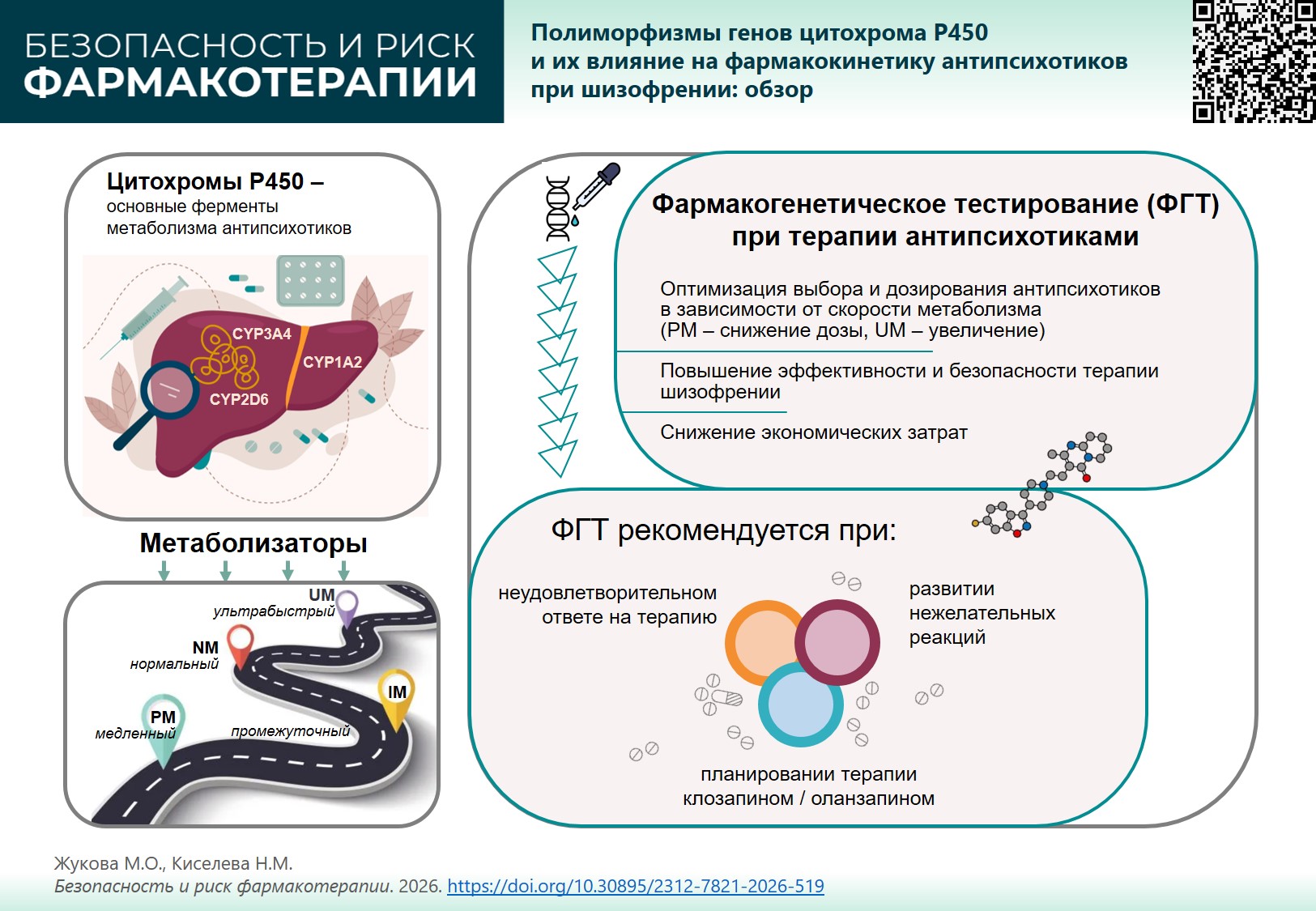
ВВЕДЕНИЕ. Активность ферментов системы цитохрома Р450 (CYP450), играющих ключевую роль в метаболизме антипсихотиков, оказывает влияние на эффективность и безопасность терапии шизофрении. Приоритетное значение для безопасности терапии имеет индивидуализация выбора препаратов и их дозы с использованием фармакогенетического тестирования.
ЦЕЛЬ. Систематизировать данные о влиянии полиморфизмов генов CYP2D6, CYP2C19, CYP1A2 и CYP3A4, кодирующих ферменты CYP450, на концентрацию антипсихотиков в плазме крови и риск нежелательных реакций для интеграции в персонализированные алгоритмы терапии.
ОБСУЖДЕНИЕ. Ключевыми факторами, определяющими эффективность и безопасность терапии антипсихотиками, являются различия в метаболизме, обусловленные полиморфизмами генов изоферментов CYP450: CYP2D6, CYP2C19, CYP1A2. Генотип пациента предопределяет фенотип метаболизма. В соответствии с уровнем активности ферментов системы CYP450 выделяют 4 основных типа метаболизаторов: медленный, промежуточный, нормальный (наиболее распространенный) и ультрабыстрый. Наиболее значимое влияние на стратегию назначения антипсихотиков, особенно второго и третьего поколений, оказывают крайние варианты метаболизаторов. Генотипы, носительство которых предопределяет скорость метаболизма, также ассоциированы с полом и этнической принадлежностью.
ВЫВОДЫ. Интеграция фармакогенетического тестирования (в первую очередь генотипирования CYP2D6) в клиническую практику позволяет оптимизировать выбор и дозирование антипсихотиков, повысить эффективность и безопасность терапии шизофрении, снизить экономические затраты. Рекомендуется проведение тестирования у пациентов с неудовлетворительным ответом на терапию, развитием нежелательных реакций или при планировании терапии клозапином/оланзапином (CYP1A2).
Жукова М.О., Киселева Н.М. Полиморфизмы генов цитохрома P450 и их влияние на фармакокинетику антипсихотиков при шизофрении: обзор. Безопасность и риск фармакотерапии. 2026;14(2):168-177. https://doi.org/10.30895/2312-7821-2026-519
Zhukova M.O., Kiseleva N.M. Cytochrome P450 Gene Polymorphisms and Their Influence on Antipsychotic Pharmacokinetics in Schizophrenia: A Review. Safety and Risk of Pharmacotherapy. 2026;14(2):168-177. (In Russ.) https://doi.org/10.30895/2312-7821-2026-519
Шизофрения — тяжелое психическое расстройство, которое может иметь хроническое течение и приводить к инвалидности. Показатель инвалидности по шизофрении в России в 2021 г. находился на уровне 226,7 на 100 тыс. населения [1]. Этиология шизофрении и патогенез до сих пор неясны. На развитие заболевания предположительно влияют как наследственные факторы, так и факторы среды (в том числе социальные)1. Эффективность и безопасность фармакотерапии антипсихотиками расстройств шизофренического спектра в значительной степени зависит от полиморфизма генов, отвечающих за активность цитохромов, участвующих в метаболизме препаратов этой группы [2]. Замедленный метаболизм у носителей нулевых аллелей (полная потеря функции фермента) повышает риск дозозависимых нежелательных реакций и создает предпосылки для накопления токсичных метаболитов, способных вызывать прямое повреждение клеток или гаптен-опосредованные иммунные реакции [3][4]. При выборе терапии необходима тщательная оценка как класс-специфических, так и индивидуальных долгосрочных рисков.
Применение антипсихотиков второго поколения (АП2) ассоциировано с развитием метаболических и эндокринных нарушений (увеличение массы тела, атерогенная дислипидемия с повышением уровней липопротеинов низкой плотности и липопротеинов очень низкой плотности, повышенный риск развития сахарного диабета II типа), а также седативным эффектом. При терапии клозапином показатель повторной госпитализации пациентов наиболее низкий [5], но препарат редко используется в качестве препарата первой линии выбора, поскольку его применение может сопровождаться развитием серьезных нежелательных реакций [6]. Применение антипсихотиков первого поколения (типичных, АП1) характеризуется развитием экстрапирамидной симптоматики (дистония, паркинсонизм, акатизии) [7][8]. Некоторые антипсихотики, чаще всего АП2, могут провоцировать удлинение интервала QT и, как следствие, развитие пируэтной тахикардии, нередко приводящей к внезапной смерти [7]. Отмечена связь применения антипсихотиков у всех метаболических фенотипов CYP2D6 и CYP2C19 (кроме пациентов с нормальным метаболизмом) с удлинением интервала QT (преимущественно у пациентов с замедленным метаболическим фенотипом по CYP2C19), увеличением веса, гормональными изменениями и повышенным риском экстрапирамидных нежелательных реакций [9].
Подбор эффективной и безопасной фармакотерапии шизофрении, позволяющей минимизировать риск рецидивов заболевания, затрудняющих социализацию пациентов, остается одной из актуальных проблем психиатрии [10]. Приоритетное значение приобретает персонализация выбора антипсихотика и его дозы с учетом полиморфизмов генов, кодирующих ферменты цитохрома Р450 (CYP450) [9][11].
Цель работы — систематизировать данные о влиянии полиморфизмов генов CYP2D6, CYP2C19, CYP1A2 и CYP3A4, кодирующих полиморфизмы CYP450, на концентрацию антипсихотиков в плазме крови и риск развития нежелательных реакций для интеграции в персонализированные алгоритмы терапии.
Проведен анализ открытых полнотекстовых публикаций, доступных для поиска по состоянию на июль 2025 г. (особое внимание уделяли статьям, опубликованным в период 2018–2025 гг.) в базах данных PubMed и КиберЛенинка по ключевым словам: шизофрения / schizophrenia; P450; метаболизм (биотрансформация) антипсихотиков / нейролептиков / metabolism (biotransformation) of antipsychotics / neuroleptics; активность цитохрома / cytochrome activity; терапия шизофрении / therapy of schizophrenia; антипсихотики / antipsychotics; продуктивная симптоматика / productive symptoms; клозапин / clozapine; фармакогенетическое тестирование / pharmacogenetic testing. Обнаружено 153 источника с различным пересечением ключевых слов. В обзор включали исследования всех дизайнов, изучающих влияние полиморфизма генов семейства CYP450 на эффективность и безопасность терапии антипсихотиками. Из анализа исключали работы с недостаточной детализацией методики исследования (дизайн, критерии включения и исключения участников, условия и продолжительность проведения исследования). Всего в анализ включены 74 публикации.
При подготовке таблицы S2 для систематизации данных о коррекции доз антипсихотиков в зависимости от фенотипа метаболизма использована платформа Consensus AI (версия 2024). По каждой паре «ген–препарат» выполняли поиск научных публикаций с последующей ручной верификацией рекомендаций в первоисточниках. Все данные подтверждены ссылками на руководства и исследования. Использование Consensus AI ограничено предварительным поиском и структурированием информации; интерпретация и отбор данных выполнены авторами самостоятельно.
Более 90% всех лекарственных средств метаболизируется в организме человека с участием ферментов системы цитохрома (CYP) семейства Р450 [11][12]. Неоднородность реакций на антипсихотики может быть обусловлена высокополиморфными генетическими вариациями изоформ CYP450 у пациентов [11][13]. В исследовании по расшифровке генома человека D.R. Nelson и соавт. (2004) представили доказательства наличия 57 различных активных генов, кодирующих CYP450, и аналогичное количество псевдогенов [14].
Ключевую роль в метаболизме антипсихотиков играют полиморфизмы генов, кодирующих CYP2D6 (имеет порядка 90 вариантов), метаболизирующий в том числе галоперидол и рисперидон, CYP1A2, отвечающий за метаболизм ряда антипсихотиков, в частности оланзапина, и CYP2C19 (имеет 3 варианта), который вместе с CYP2D6 отвечает за биотрансформацию клозапина [11][12][15]. Пути метаболизма антипсихотиков представлены подробно в работе Н.А. Шнайдер и соавт. (2022) [4]. Для ферментов системы CYP450 традиционно выделяют следующие генетически детерминированнные фенотипы: медленные метаболизаторы (poor metabolizers, PM), быстрые / нормальные метаболизаторы (extensive metabolizers EM / normal metabolizers NM), промежуточные метаболизаторы (intermediate metabolizers, IM) и ультрабыстрые метаболизаторы (ultrarapid metabolizers, UM) [16–19]. У PM отсутствует активный фермент из-за нефункциональных генов, у IM обычно есть один функциональный и один дефектный или нулевой аллель, что приводит к снижению активности фермента. NM и UM обычно имеют несколько копий функционального гена или обладают вариантами, которые усиливают экспрессию гена [20][21]. Распределение аллелей зависит в том числе от расы, пациенты с шизофренией с различной этнической принадлежностью могут по-разному реагировать на один и тот же препарат (табл. S1, размещена на сайте журнала2) [22–43].
Наиболее значимыми в метаболизме антипсихотиков являются ферменты CYP2D6 и CYP2C19. Крайние вариации фенотипов CYP2D6 встречаются намного реже во всех этнических группах. Так, у европейцев частота встречаемости PM составляет порядка 5–10%, а UM — 1–8,3%, в азиатских — 1–2% [22–30]. CYP2D6 — самый полиморфный из всех ферментов CYP. У европеоидов наиболее частыми нулевыми (нефункциональными) аллелями являются CYP2D6*4 (частота аллеля около 20–25% (примерно 70–90% PM), которые содержат консенсусную мутацию сайта сплайсинга (1846G>A), приводящую к отсутствию белка CYP2D6 в печени [22][25], в азиатских популяциях выше доля аллеля CYP2D6*10, связанного с пониженной активностью фермента, который во многом зависит от национальности [25][28].
Около 2–5% европеоидов и африканцев и до 23% азиатов являются PM по CYP2C19. Высокая распространенность нулевых аллелей объясняет большую изменчивость и сильные корреляции фенотипа и генотипа для CYP2C19 (CYP2C19*2 у европеоидов, CYP2C19*3 у азиатов) [34].
Полиморфизм CYP2D6 играет значительную роль в биотрансформации и нейротрансмиссии центрального дофамина: CYP2D6 катализирует гидроксилирование тирамина в дофамин. Для пациентов, являющихся NM по CYP2D6, характерна более выраженная положительная динамика уменьшения продуктивной симптоматики на фоне применения антипсихотиков по сравнению с IM [9][18][21].
Примерно 50% лекарственных препаратов метаболизируется ферментами семейства CYP3A. Ген CYP3A43 кодирует соответствующий фермент, который участвует в метаболизме некоторых АП2, в частности оланзапина [44]. Поскольку фермент имеет высокий уровень экспрессии в головном мозге [45], можно предположить, что существуют значимые различия в уровнях оланзапина в месте его терапевтического действия [45][46]. Активность ферментов CYP3A4 у женщин превышает таковую у мужчин [46] в связи с влиянием женских половых гормонов — эстрогена и прогестерона. Активность CYP3A4 у женщин в пременопаузе выше, что важно для метаболизма кветиапина и луразидона [46]. В результате возможно снижение эффективности терапии у женщин, поскольку указанные антипсихотики быстрее метаболизируются и, следовательно, обладают меньшей эффективностью [47]. Для большинства АП2 (например, рисперидон и оланзапин) вклад CYP3A4 в метаболизм препаратов второстепенный [48].
Фармакогенетическое тестирование позволяет минимизировать побочное действие антипсихотиков и адаптировать дозу препарата с учетом особенностей пациента. Для EM рекомендуется увеличение дозы, в то время как для PM может потребоваться ее снижение, чтобы избежать токсичности [9][18][49]. Аллели с потерей функции CYP2D6 могут способствовать развитию поздней дискинезии у пациентов с шизофренией [50]. Голландская рабочая группа по фармакогенетике (Dutch Pharmacogenetics Working Group, DPWG), выступающая за внедрение фармакогенетики в клиническую практику, выпустила ряд рекомендаций по дозированию препарата в зависимости от типа метаболизма по CYP450. Исследователи DPWG указали на необходимость корректировки терапии в зависимости от генотипа для CYP2D6 при применении арипипразола, брекспипразола, галоперидола, пимозида, рисперидона и зуклопентиксола, а также для CYP3A4 при применении кветиапина и приводит четкие рекомендации [20]. DPWG не рекомендует рутинное генотипирование CYP2D6 и CYP3A4 для всех пациентов перед назначением антипсихотиков. Решение о тестировании должно приниматься индивидуально, исходя из клинической ситуации.
В исследовании J.J. Swen и соавт. (2023) показано, что фармакогенетическое тестирование перед началом лекарственной терапии с использованием панелей из 12 генов в соответствии с рекомендациями DPWG снизило частоту развития нежелательных реакций на 30% [51].
В описанном F. Facal (2023) клиническом случае у пациента с полной делецией CYP2D6 (*5/*5, PM) наблюдались нежелательные реакции при применении пимозида (вторичный паркинсонизм, снижение аппетита и веса вплоть до кахексии, снижение артериального давления); симптомы исчезли после отмены препарата. Фармакогенетическое тестирование в данном случае позволило бы предотвратить тяжелые осложнения и повторную госпитализацию [52]. Риск развития экстрапирамидного синдрома или тардивной дискинезии существенно более высокий у PM по CYP2D6 в сравнении с IM/EM при сопоставимых дозах и препаратах. Отдельные аллели *4 и *6 значимо повышают риск экстрапирамидных нарушений (OR≈4–5) [53][54].
В руководстве L. Beunk и соавт. (2024) на основе систематического обзора проведен анализ влияния генов CYP2D6, CYP3A4 и CYP1A2 на фармакокинетику, метаболизм и терапевтический эффект антипсихотиков и представлены рекомендации коррекции терапии [20]. В частности, для пациентов с CYP2D6-прогнозируемым медленным метаболизмом следует уменьшить дозы галоперидола и рисперидона. Авторы полагают, что критерием для проведения генотипирования CYP2D6/CYP3A4 является наличие проблем, связанных с приемом нескольких нейролептиков или других препаратов, метаболизируемых CYP2D6/CYP3A4.
Пациентам с аллельным вариантом CYP2D6 (*4, 5, 6, 7, 9, 10, 41 — функционально дефектные, снижающие или полностью блокирующие активность фермента CYP2D6 [55]) не следует назначать галоперидол и другие АП1, так как медленное выведение антипсихотика приводит к развитию нежелательных реакций, которых можно избежать при применении АП2. У UM, напротив, эффективность антипсихотика в стандартной дозе будет недостаточной, что приведет к прогрессированию заболевания.
Результаты исследования M.J. Arranz и соавт. (2019) показали, что для подбора терапии антипсихотиками рекомендуется анализировать полиморфизмы CYP2D6, CYP1A2 и CYP2C19, а также, по возможности, ABCB1. В зависимости от генотипических вариантов CYP1A2 и CYP2C19 была скорректирована доза клозапина, в соответствии с полиморфизмом CYP1A2 — оланзапина, с полиморфизмом CYP2D6 — рисперидона, арипипразола, галоперидола, пимозида и трифлуоперазина, CYP3A5 — кветиапина и зипрасидона [56].
В слепом рандомизированном контролируемом исследовании Z. Kang и соавт. (2023), включавшем 210 госпитализированных пациентов китайской народности хань с диагнозом «шизофрения» (мужчины в возрасте от 18 до 60 лет), 113 участникам проведено мультигенетическое фармакогеномное тестирование [57]. Все участники в течение 1 нед. получали низкодозовую терапию рисперидона (2 мг/сут или меньше) или эквивалентную дозу другого антипсихотического препарата. У всех участников были проанализированы однонуклеотидные варианты в 26 аллелях в 11 генах. Терапия с учетом результатов тестирования была подобрана 113 участникам (8 широко используемых АП2 и антипсихотиков третьего поколения (АП3): амисульприд, арипипразол, клозапин, оланзапин, палиперидон, кветиапин, рисперидон и зипрасидон). Остальные 97 человек получали стандартное лечение. У пациентов первой группы через 12 нед. эффективность лечения была выше, чем у пациентов, которым препарат был назначен без учета типа метаболизма. Генетические варианты CYP1A2 были ассоциированы с метаболизмом клозапина, CYP2D6 — с метаболизмом арипипразола и рисперидона, CYP3A4 — кветиапина [57]. Выраженное влияние полиморфизмов CYP1A2 на скорость метаболизма клозапина и оланзапина отмечено и в других работах [56][58]: определение активности данного цитохрома позволяет снизить риск токсического действия и индивидуализировать дозирование. Крайние варианты CYP2D6 (PM и UM) участвуют в метаболизме многих антипсихотиков, особенно препаратов с единственным метаболическим путем. Пациенты с фенотипами медленного или промежуточного метаболизма CYP2D6 подвержены большему риску развития нежелательных реакций на рисперидон и галоперидол [59].
Сходные результаты были получены и в исследовании Y. Qin и соавт. (2024), проведенном с участием 186 взрослых пациентов с шизофренией [60]. Пациентам первой группы проводился фармакогенетический анализ, в соответствии с результатами которого корректировали схему приема антипсихотиков. В контрольной группе терапию подбирали согласно действующим клиническим рекомендациям. На 12 нед. в группе, пациентам которой терапия была назначена с учетом типа метаболизма, уровень ответа на лечение значительно превысил эффективность в группе стандартной терапии (81,7 vs 48,8%) [60].
Следует учитывать особую роль в метаболизме антипсихотиков фермента CYP2C19, а именно наличие мутаций *3 и *2 в кодирующем его гене (переход гуанина в аденин в позиции 681 экзона), что приводит к альтернативному сплайсингу и преждевременному стоп-кодону в гене [61]. По нашему мнению, наличие у пациента такой мутации может требовать более высокой дозы препарата для достижения терапевтического эффекта или замены терапии.
В соответствии с рекомендациями Группы исследований исходов при шизофрении (Schizophrenia Patient Outcomes Research Team, PORT) сохранение постоянной терапевтической дозы и полный непрерывный курс поддерживающего приема антипсихотиков способствуют уменьшению симптоматики и снижению риска повторной госпитализации (особенно при приеме АП2) [62][63]. Обзор и систематический метаанализ J.P.A.M. Bogers и соавт. (2020) данных 40 публикаций (январь 1950 г. — июнь 2019 г., 1 677 пациентов) подтвердил повышенный риск обострения у пациентов с хроническим течением шизофрении при снижении дозы антипсихотика, дозе менее 5 мг в галоперидоловом эквиваленте или полной отмене препарата [64].
Снижение дозы АП1 при поддерживающем лечении шизофрении связано с попыткой снизить дозозависимые нежелательные реакции. Как правило, при отсутствии положительной динамики через 4–6 нед. производится смена препарата, что в некоторых случаях позволяет улучшить состояние пациента3, при этом важно провести точный индивидуальный подбор наиболее эффективного лекарственного средства с учетом генетических особенностей пациента, определяющих скорость метаболизма.
Применение фармакогенетического тестирования не только повышает эффективность терапии, но и позволяет снизить общие затраты на лечение антипсихотиками на 28% [65]. В работе А.А. Курылева и соавт. (2018) обоснована экономическая выгода фармакогенетического подхода при назначении антипсихотической терапии, показано снижение суммарных медицинских затрат на примере генотипирования CYP2D6. Стоимость теста составила <1% общих затрат. Сокращение времени подбора антипсихотической терапии уменьшает длительность госпитализации пациента [66]. В многоцентровом исследовании в Испании у пациентов с психическими расстройствами (модель 5-Step Precision Medicine, включающая 5 этапов: сбор клинических, эпидемиологических и терапевтических данных; фармакологические взаимодействия; фармакогенетический анализ с использованием мультигенной панели (CYP1A2, CYP2B6, CYP2C9, CYP2C19, CYP2D6, CYP3A5 и ABCB1); коррекция лечения и эффективности) продемонстрировано снижение общих прямых затрат на госпитализацию и фармакотерапию у 67% пациентов, с коэффициентом «выгода/затраты» 3,31–3,59 (каждый евро на тест приносил >3 евро экономии) [67]. Систематический обзор 13 исследований по антипсихотикам показал, что суммарные госпитальные расходы на лечение после внедрения фармакогенетического подхода снизились на 59% [68].
Рекомендации по персонализированному выбору антипсихотической терапии, основанному на данных фармакогенетического тестирования, обобщены в таблице S2 (размещенана сайте журнала4) [18–20][48][58][69–83].
Анализ данных таблицы S2 показал, что наибольшая роль в метаболизме антипсихотиков разных поколений (АП1, АП2, АП3) принадлежит СYP2D6. Для PM необходимо снижать дозы галоперидола, пимозида, зуклопентиксола, арипипразола, брекспипразола и рисперидона [19][20][48][58][69–72], для IM снижать дозу пимозида и зуклопентиксола [18–20][48][58][69–71][73]. Для остальных антипсихотиков, зависимых от полиморфизма CYP2D6, требуется терапевтический лекарственный мониторинг (therapeutic drug monitoring, TDM) [20][48][69], для UM при использовании галоперидола, рисперидона и зуклопентиксола — увеличение дозы при недостаточной эффективности или замена антипсихотического средства [18–20][58][69][70–74].
Вклад полиморфизмов CYP3A4*22, CYP1A2 (*1F, *1C, *1D) и CYP2C19 в метаболизм АП1 минимален и не влияет на клинический эффект [19][20][56][58][69][70][75–81]. При сочетании полиморфизмов генов CYP2D6 и CYP3A4 с фенотипом PM снижается элиминация кветиапина и арипипразола, в таком случае дозы рекомендуется снижать [82].
При наличии CYP1A2*1F дозы клозапина у курильщиков необходимо увеличивать, поскольку в этом случае наблюдается ультрабыстрый клиренс препарата [69]. В то же время при наличии CYP1A2(*1C/*1D) дозы клозапина следует снижать из-за замедления элиминации препарата [79]. Также имеются сведения, что при наличии полиморфизма CYP2C19 требуется TDM и коррекция дозы клозапина (уменьшение дозы при PM и увеличение при UM) [83].
Индивидуальные различия в метаболизме антипсихотиков обусловлены генетическими полиморфизмами генов, кодирующих изоферменты CYP450 (наибольший вклад отмечен для CYP2D6). Рекомендуется проведение тестирования у пациентов с неудовлетворительным ответом на терапию, развитием нежелательных реакций или при планировании терапии клозапином/оланзапином (CYP1A2). В большей степени это значимо для пациентов с крайними типами метаболизма (PM и UM), особенно при выборе АП2 и АП3. Пациентам с медленным типом метаболизма требуется снижение дозы из-за замедления скорости элиминации препарата из организма. Предотвращение кумуляции антипсихотика позволяет снижать риск развития нежелательных реакций, таких как седация, экстрапирамидные расстройства, гиперпролактинемия, а в случае использования АП2 — метаболических нарушений. Пациентам с ультрабыстрым метаболизмом, наоборот, требуются более высокие дозы антипсихотиков для развития и сохранения терапевтического действия. Аллельное распределение зависит от этнической принадлежности пациента, зависимость от пола и возраста отмечена в отношении активности ферментов CYP3A4.
Дополнительная информация. Таблицы S1 и S2 размещены на сайте журнала «Безопасность и риск фармакотерапии».
https://doi.org/10.30895/2312-7821-2025-519-tabl
Вклад авторов. Все авторы подтверждают соответствие своего авторства критериям ICMJE. Наибольший вклад распределен следующим образом: Жукова М.О. — сбор и анализ литературы, написание текста рукописи; Киселева Н.М. — концепция исследования, утверждение окончательного варианта рукописи для публикации.
Использование генеративного искусственного интеллекта. Авторы заявляют, что при подготовке рукописи использовали генеративный ИИ в соответствии с политикой журнала в отношении ИИ. Подробная информация указана в конце раздела «Введение».
Supplementary information. Tables S1 and S2 are available on the website of Safety and Risk of Pharmacotherapy.
https://doi.org/10.30895/2312-7821-2025-519-tabl
Author contributions. All authors confirm that they meet the ICMJE criteria for authorship. The most significant contributions were as follows. Maria O. Zhukova collected and analyzed literature and drafted the manuscript. Nina M. Kiseleva conceptualized the study and approved the final version of the manuscript for publication.
Use of generative artificial intelligence. The authors declare that generative AI was used during the preparation of this manuscript in compliance with the journal's policy on AI. Detailed information is provided at the end of the “Introduction” section.
1. Шизофрения у взрослых. Клинические рекомендации. Минздрав России; 2024.
2. https://doi.org/10.30895/2312-7821-2026-519-tabl
3. Шизофрения у взрослых. Клинические рекомендации. Минздрав России; 2024.
4. https://doi.org/10.30895/2312-7821-2026-519-tabl
1. Макушкина ОА, Яздовская АВ. Психиатрическая служба Российской Федерации: вопросы организации и мониторинг показателей (2011–2021 гг.). Сибирский вестник психиатрии и наркологии. 2022;117(4):72–82. https://doi.org/10.26617/1810-3111-2022-4(117)-72-82
2. Grădinaru R, Andreescu N, Nussbaum L, et al. Impact of the CY-P2D6 phenotype on hyperprolactinemia development as an adverse event of treatment with atypical antipsychotic agents in pediatric patients. Ir J Med Sci. 2019;188(4):1417–22. https://doi.org/10.1007/s11845-019-01985-x
3. Bradford L. CYP2D6 allele frequency in European Caucasians, Asians, Africans and their descendants. Pharmacogenomics. 2002;3(2):229–43. https://doi.org/10.1517/14622416.3.2.229
4. Шнайдер НА, Хасанова АК, Насырова РФ. Первая фаза метаболизма антипсихотиков в печени: роль окисления. Фармакогенетика и фармакогеномика. 2022;(1):15–30. https://doi.org/10.37489/2588-0527-2022-1-15-30
5. Goody J, Petersen K, Brink J, et al. Antipsychotic prescribing practices and their association with rehospitalization in a forensic psychiatric sample. Front Psychiatry. 2024;15:1474626. https://doi.org/10.3389/fpsyt.2024.1474626
6. Vermeulen JM, van Rooijen G, van de Kerkhof MP, et al. Clozapine and long-term mortality risk in patients with schizophrenia: A systematic review and meta-analysis of studies lasting 1.1–12.5 years. Schizophr Bulletin. 2019;45(2):315–29. https://doi.org/10.1093/schbul/sby052
7. Stroup TS, Gray N. Management of common adverse effects of antipsychotic medications. World Psychiatry. 2018;17(3):341–56. https://doi.org/10.1002/wps.20567
8. McDonagh MS, Dana T, Selph S, et al. Updating the comparative evidence on second-generation antipsychotic use with schizophrenia. Psychiatr Res Clin Pract. 2020;2(2):76–87. https://doi.org/10.1176/appi.prcp.20200004
9. Walden LM, Brandl EJ, Tiwari AK, et al. Genetic testing for CYP2D6 and CYP2C19 suggests improved outcome for antidepressant and antipsychotic medication. Psychiatry Res. 2019;279:111–5. https://doi.org/10.1016/j.psychres.2018.02.055
10. Ayre MJ, Lewis PJ, Keers RN. Understanding the medication safety challenges for patients with mental illness in primary care: A scoping review. BMC Psychiatry. 2023;23(1):417. https://doi.org/10.1186/s12888-023-04850-5
11. Zanger UM, Schwab M. Cytochrome P450 enzymes in drug metabolism: Regulation of gene expression, enzyme activities, and impact of genetic variation. Pharmacol Ther. 2013;138(1):103–41. https://doi.org/10.1016/j.pharmthera.2012.12.007
12. Shnayder NA, Abdyrakhmanova AK, Nasyrova RF. Phase I of antipsychotics metabolism and its pharmacogenetic testing. Personalized Psychiatry and Neurology. 2022;2(1):4–21. https://doi.org/10.52667/2712-9179-2022-2-1-4-21
13. Zhang, Y, Wang, Z, Wang, Y, et al. CYP3A4 and CYP3A5: The crucial roles in clinical drug metabolism and the significant implications of genetic polymorphisms. PeerJ. 2024;12:e18636. https://doi.org/10.7717/peerj.18636
14. Nelson DR, Zeldin DC, Hoffman SM, et al. Comparison of cytochrome P450 (CYP) genes from the mouse and human genomes, including nomenclature recommendations for genes, pseudogenes and alternative-splice variants. Pharmacogenetics. 2004;14(1):1–18. https://doi.org/10.1097/00008571-200401000-00001
15. Байрамова СП, Павлова ОВ, Шпорт СВ и др. Связь изоформ цитохрома P450 с эффективностью и безопасностью терапии антипсихотиками и антидепрессантами. Журнал неврологии и психиатрии им. С.С. Корсакова. 2023;123(11):40–6. https://doi.org/10.17116/jnevro202312311140
16. Caudle KE, Sangkuhl K, Whirl-Carrillo M, et al. Standardizing CYP2D6 genotype to phenotype translation: Consensus recommendations from the clinical pharmacogenetics implementation consortium and dutch pharmacogenetics working group. Clin Transl Sci. 2020;13(1):116–24. https://doi.org/10.1111/cts.12692
17. Wannasuphoprasit Y, Andersen SE, Arranz MJ, et al. CYP2D6 genetic variation and antipsychotic-induced weight gain: A systematic review and meta-analysis. Front Psychol. 2022;12:768748. https://doi.org/10.3389/fpsyg.2021.768748
18. Kneller LA, Zubiaur P, Koller D, et al. Influence of CYP2D6 phenotypes on the pharmacokinetics of aripiprazole and dehydro-aripiprazole using a physiologically based pharmacokinetic approach. Clin Pharmacokinet. 2021;60(12):1569–82. https://doi.org/10.1007/s40262-021-01041-x
19. Milosavljevic F, Bukvic N, Pavlovic Z, et al. Association of CYP2C19 and CYP2D6 poor and intermediate metabolizer status with antidepressant and antipsychotic exposure: A systematic review and meta-analysis. JAMA Psychiatry. 2021;78(3):270–80. https://doi.org/10.1001/jamapsychiatry.2020.3643
20. Beunk L, Nijenhuis M, Soree B, et al. Dutch Pharmacogenetics Working Group (DPWG) guideline for the gene-drug interaction between CYP2D6, CYP3A4 and CYP1A2 and antipsychotics. Eur J Hum Genet. 2024;32(3):278–85. https://doi.org/10.1038/s41431-023-01347-3
21. Голоенко ИМ, Объедков ВГ, Голубева ТС и др. Актуальность фармакогенетического тестирования при антипсихотической терапии шизофрении. Молекулярная и прикладная генетика. 2023;34:121–32. EDN: NQBUSQ
22. LLerena A, Naranjo M, Rodrigues-Soares F, et al. Interethnic variability of CYP2D6 alleles and of predicted and measured metabolic phenotypes across world populations. Expert Opin Drug Metab Toxicol. 2014;10(11):1569–83. https://doi.org/10.1517/17425255.2014.964204
23. Mizutani T. PM frequencies of major CYPs in Asians and Caucasians. Drug Metab Rev. 2003;35(2–3):99–106. https://doi.org/10.1081/dmr-120023681
24. Zhou Y, Lauschke V. The genetic landscape of major drug metabolizing cytochrome P450 genes — An updated analysis of population-scale sequencing data. Pharmacogenomics J. 2022;22(5–6):284–93. https://doi.org/10.1038/s41397-022-00288-2
25. Табиханова ЛЭ, Осипова ЛП, Чуркина ТВ и др. Полиморфизм генов CYP1A1 и CYP2D6 в популяциях бурят, телеутов и у русских Восточной Сибири. Вавиловский журнал генетики и селекции. 2018;22(2):205–11. https://doi.org/10.18699/VJ18.348
26. Byeon J, Kim Y, Lee C, et al. CYP2D6 allele frequencies in Korean population, comparison with East Asian, Caucasian and African populations, and the comparison of metabolic activity of CYP2D6 genotypes. Arch Pharm Res. 2018;41(9):921–30. https://doi.org/10.1007/s12272-018-1075-6
27. Kopmans A, Braakman M, Vinkers D, et al. Meta-analysis of probability estimates of worldwide variation of CYP2D6 and CYP2C19. Transl Psychiatry. 2021;11(1):141. https://doi.org/10.1038/s41398-020-01129-1
28. Li Y, Huang W, Xiao M, et al. CYP2D6 gene polymorphisms and variable metabolic activity in schizophrenia patients of Han and Tibetan populations. Neuropsychiatr Dis Treat. 2022;18:731–6. https://doi.org/10.2147/ndt.s355985
29. Gaedigk A, Sangkuhl K, Whirl-Carrillo M, et al. Prediction of CYP2D6 phenotype from genotype across world populations. Genet Med. 2016;19(1):69–76. https://doi.org/10.1038/gim.2016.80
30. Petrović J, Pešić V, Lauschke V. Frequencies of clinically important CYP2C19 and CYP2D6 alleles are graded across Europe. Eur J Hum Genet. 2020;28(1):88–94. https://doi.org/10.1038/s41431-019-0480-8
31. Scordo M, Caputi A, D’Arrigo C, et al. Allele and genotype frequencies of CYP2C9, CYP2C19 and CYP2D6 in an Italian population. Pharmacol Res. 2004;50(2):195–200. https://doi.org/10.1016/j.phrs.2004.01.004
32. Gaikovitch E, Cascorbi I, Mrozikiewicz P, et al. Polymorphisms of drug-metabolizing enzymes CYP2C9, CYP2C19, CYP2D6, CYP1A1, NAT2 and of P-glycoprotein in a Russian population. Eur J Clin Pharmacol. 2003;59(4):303–12. https://doi.org/10.1007/s00228-003-0606-2
33. Fricke-Galindo I, Céspedes-Garro C, Rodrigues-Soares F, et al. Interethnic variation of CYP2C19 alleles, ‘predicted’ phenotypes and ‘measured’ metabolic phenotypes across world populations. Pharmacogenomics J. 2015;16(2):113–23. https://doi.org/10.1038/tpj.2015.70
34. Goldstein JA, Ishizaki T, Chiba K, et al. Frequencies of the defective CYP2C19 alleles responsible for the mephenytoin poor metabolizer phenotype in various Oriental, Caucasian, Saudi Arabian and American black populations. Pharmacogenetics. 1997;7(1):59–64. https://doi.org/10.1097/00008571-199702000-00008
35. Riaz S, Din S, Tareen M, et al. Genetic polymorphism of CYP2C19 in Pakistani population. Iran J Pharm Res. 2019;18(2):1097–102. https://doi.org/10.22037/ijpr.2019.1100644
36. Nieh H, Roman Y. Major allele frequencies in CYP2C9 and CYP2C19 in Asian and European populations: A case study to disaggregate data among large racial categories. J Pers Med. 2025;15(7):274. https://doi.org/10.3390/jpm15070274
37. Guevara M, Rodrigues-Soares F, De La Cruz C, et al. Afro-Latin American pharmacogenetics of CYP2D6, CYP2C9, and CYP2C19 in Dominicans: A study from the RIBEF-CEIBA consortium. Pharmaceutics. 2024;16(11):1399. https://doi.org/10.3390/pharmaceutics16111399
38. Skadrić I, Stojković O. Defining screening panel of functional variants of CYP1A1, CYP2C9, CYP2C19, CYP2D6, and CYP3A4 genes in Serbian population. Int J Legal Med. 2020;134(2):433–9. https://doi.org/10.1007/s00414-019-02234-7
39. Lee J, Cheong H, Kim L, et al. Screening of genetic polymorphisms of CYP3A4 and CYP3A5 genes. Korean J Physiol Pharmacol. 2013;17(6):479–84. https://doi.org/10.4196/kjpp.2013.17.6.479
40. Drögemöller B, Plummer M, Korkie L, et al. Characterization of the genetic variation present in CYP3A4 in three South African populations. Front Genet. 2013;4:17. https://doi.org/10.3389/fgene.2013.00017
41. Guttman Y, Nudel A, Kerem Z. Polymorphism in cytochrome P450 3A4 is ethnicity related. Front Genet. 2019;10:224. https://doi.org/10.3389/fgene.2019.00224
42. Fohner A, Dalton R, Skagen K, et al. Characterization of CYP3A pharmacogenetic variation in American Indian and Alaska Native communities, targeting CYP3A4*1G allele function. Clin Transl Sci. 2021;14(4):1292–302. https://doi.org/10.1111/cts.12970
43. Qi G, Han C, Zhou Y, Wang X. Allele and genotype frequencies of CYP3A4, CYP3A5, CYP3A7, and GSTP1 gene polymorphisms among mainland Tibetan, Mongolian, Uyghur, and Han Chinese populations. Clin Exp Pharmacol Physiol. 2022;49(2):219–27. https://doi.org/10.1111/1440-1681.13604
44. Bigos KL, Bies RR, Pollock BG, et al. Genetic variation in CYP3A43 explains racial difference in olanzapine clearance. Mol Psychiatry. 2011;16(6):620–5. https://doi.org/10.1038/mp.2011.38
45. Agarwal V, Kommaddi RP, Valli K, et al. Drug metabolism in human brain: High levels of cytochrome P4503A43 in brain and metabolism of anti-anxiety drug alprazolam to its active metabolite. PLoS One. 2008;3(6):e2337. https://doi.org/10.1371/journal.pone.0002337
46. Brand BA, Haveman YRA, de Beer F, et al. Antipsychotic medication for women with schizophrenia spectrum disorders. Psychol Med. 2022;52(4):649–63. https://doi.org/10.1017/S0033291721004591
47. Han L, Gu J, Mao J, et al. Insights into the population pharmacokinetics and pharmacodynamics of quetiapine: A systematic review. Expert Rev Clin Pharmacol. 2023;17(1):57–72. https://doi.org/10.1080/17512433.2023.2295428
48. Soria-Chacartegui P, Villapalos-García G, Zubiaur P, et al. Genetic polymorphisms associated with the pharmacokinetics, pharmacodynamics and adverse effects of olanzapine, aripiprazole and risperidone. Front Pharmacol. 2021;12:711940. https://doi.org/10.3389/fphar.2021.711940
49. Plesnicar BK, Zalar B, Breskvar K, Dolzan V. The influence of the CYP2D6 polymorphism on psychopathological and extrapyramidal symptoms in the patients on long-term antipsychotic treatment. J Psychopharmacol. 2006;20(6):829–33. https://doi.org/10.1177/0269881106062894
50. Patsopoulos NA, Ntzani EE, Zintzaras E, Ioannidis JP. CYP2D6 polymorphisms and the risk of tardive dyskinesia in schizophrenia: A meta-analysis. Pharmacogenet Genomics. 2005;15(3):151–8. https://doi.org/10.1097/01213011-200503000-00003
51. Swen JJ, van der Wouden CH, Manson LE, et al. A 12-gene pharmacogenetic panel to prevent adverse drug reactions: an open-label, multicentre, controlled, cluster-randomised crossover implementation study. Lancet. 2023;401(10374):347–56. https://doi.org/10.1016/S0140-6736(22)01841-4
52. Facal F, Portela B, Gil-Rodríguez A, et al. Deletion of the CYP2D6 gene as a likely explanation for the serious side effects of the antipsychotic drug pimozide: A case report. Front Pharmacol. 2023;14:1237446. https://doi.org/10.3389/fphar.2023.1237446
53. Kobylecki C, Jakobsen K, Hansen T, et al. CYP2D6 genotype predicts antipsychotic side effects in schizophrenia inpatients: A retrospective matched case-control study. Neuropsychobiology. 2009;59(4):222–6. https://doi.org/10.1159/000223734
54. Crescenti A, Mas S, Gassó P, et al. Cyp2d6*3, *4, *5 and *6 polymorphisms and antipsychotic-induced extrapyramidal side-effects in patients receiving antipsychotic therapy. Clin Exp Pharmacol Physiol. 2008;35(7):807–11. https://doi.org/10.1111/j.1440-1681.2008.04918.x
55. Kibitov AA, Kiryanova EM, Salnikova LI, et al. The ANKK1/DRD2 gene TaqIA polymorphism (rs1800497) is associated with the severity of extrapyramidal side effects of haloperidol treatment in CYP2D6 extensive metabolizers with schizophrenia spectrum disorders. Drug Metab Pers Ther. 2022;38(2):133–42. https://doi.org/10.1515/dmpt-2022-0143
56. Arranz MJ, Gonzalez-Rodriguez A, Perez-Blanco J, et al. A pharmacogenetic intervention for the improvement of the safety profile of antipsychotic treatments. Transl Psychiatry. 2019;9(1):177. https://doi.org/10.1038/s41398-019-0511-9
57. Kang Z, Qin Y, Sun Y, et al. Multigenetic pharmacogenomics-guided treatment vs treatment as usual among hospitalized men with schizophrenia: A randomized clinical trial. JAMA Netw Open. 2023;6(10):e2335518. https://doi.org/10.1001/jamanetworkopen.2023.35518
58. Hernandez M, Cullell N, Cendros M, et al. Clinical utility and implementation of pharmacogenomics for the personalisation of antipsychotic treatments. Pharmaceutics. 2024;16(2):244. https://doi.org/10.3390/pharmaceutics16020244
59. Skryabin VY, Zastrozhin MS, Parkhomenko AA, et al. Investigating the use of pharmacogenetic and pharmacometabolic markers to predict haloperidol efficacy and safety rates. Hosp Pharm. 2023;58(4):363–7. https://doi.org/10.1177/00185787231155842
60. Qin Y, Liu Y, Zhao J, et al. Pharmacogenetic intervention improves treatment outcomes in Chinese adult men with schizophrenia. J Psychiatr Res. 2024;174:129–36. https://doi.org/10.1016/j.jpsychires.2024.04.020
61. Сычев ДА, Раменская ГВ, Игнатьев ИВ, Кукес ВГ. Клиническая фармакогенетика. М.: ГЭОТАР-Медиа; 2007. Sychev DA, Ramenskaya GV, Ignatyev IV, Kukes VG. Clinical pharmacogenetics. Moscow: GEOTAR-Media; 2007 (In Russ.).
62. Buchanan RW, Kreyenbuhl J, Kelly DL, et al. Schizophrenia Patient Outcomes Research Team (PORT). The 2009 schizophrenia PORT psychopharmacological treatment recommendations and summary statements. Schizophr Bull. 2010;36(1):71–93. https://doi.org/10.1093/schbul/sbp116
63. Kreyenbuhl J, Buchanan RW, Dickerson FB, Dixon LB. Schizophrenia Patient Outcomes Research Team (PORT). The Schizophrenia Patient Outcomes Research Team (PORT): Updated treatment recommendations 2009. Schizophr Bull. 2010;36(1):94–103. https://doi.org/10.1093/schbul/sbp130
64. Bogers JPAM, Hambarian G, Michiels M., et al. Risk factors for psychotic relapse after dose reduction or discontinuation of antipsychotics in patients with chronic schizophrenia. A systematic review and meta-analysis. Schizophr Bull. 2020;46(1):sgaa002. https://doi.org/10.1093/schizbullopen/sgaa002
65. Herbild L, Andersen SE, Werge T, et al. Does pharmacogenetic testing for CYP450 2D6 and 2C19 among patients with diagnoses within the schizophrenic spectrum reduce treatment costs? Basic Clin Pharmacol Toxicol. 2013;113(4):266–72. https://doi.org/10.1111/bcpt.12093
66. Курылев АА, Андреев БВ, Колбин АС, Лиманкин ОВ. Генотипирование CYP2D6 в практике психиатрического стационара — фармакоэкономические аспекты. ФАРМАКОЭКОНО МИКА. Современная фармакоэкономика и фармакоэпидемиология. 2018;11(1):19–26 https://doi.org/10.17749/2070-4909.2018.11.1.019-026
67. Carrascal-Laso L, Franco-Martin M, Marcos-Vadillo E, et al. Economic impact of the application of a precision medicine model (5SPM) on psychotic patients. Pharmacogenomics Pers Med. 2021;14:1015–25. https://doi.org/10.2147/pgpm.s320816
68. Khani N, Hudson G, Mills G, et al. A systematic review of pharmacogenetic testing to guide antipsychotic treatment. Nat Ment Health. 2024;2(5):616–26. https://doi.org/10.1038/s44220-024-00240-2
69. Baldacci A, Saguin E, Balcerac A, et al. Pharmacogenetic guidelines for psychotropic drugs: optimizing prescriptions in clinical practice. Pharmaceutics. 2023;15(11):2540. https://doi.org/10.3390/pharmaceutics15112540
70. Ravyn D, Ravyn V, Lowney R, Nasrallah H. CYP450 Pharmacogenetic treatment strategies for antipsychotics: A review of the evidence. Schizophr Res. 2013;149(1–3):1–14. https://doi.org/10.1016/j.schres.2013.06.035
71. Jukic M, Smith R, Haslemo T, et al. Effect of CYP2D6 genotype on exposure and efficacy of risperidone and aripiprazole: A retrospective, cohort study. Lancet Psychiatry. 2019;6(5):418–26. https://doi.org/10.1016/s2215-0366(19)30088-4
72. Zhang L, Brown SJ, Shan Y, et al. CYP2D6 genetic polymorphisms and risperidone pharmacokinetics: A systematic review and meta-analysis. Pharmacotherapy. 2020;40(7):632–47. https://doi.org/10.1002/phar.2434
73. Gras C, Piras M, Ranjbar S, et al. Influence of CYP2D6 genotypes and phenotypes on the plasma levels and clinical response to aripiprazole. Schizophr Bull. 2025;52(2):sbaf076. https://doi.org/10.1093/schbul/sbaf076
74. Thümmler S, Dor E, David R, et al. Pharmacoresistant severe mental health disorders in children and adolescents: Functional abnormalities of cytochrome P450 2D6. Front Psychiatry. 2018;9:2. https://doi.org/10.3389/fpsyt.2018.00002
75. lchakee A, Ahmed M, Eldohaji L, et al. Pharmacogenomics in psychiatry practice: The value and the challenges. Int J Mol Sci. 2022;23(21):13485. https://doi.org/10.3390/ijms232113485
76. Na Takuathung M, Hanprasertpong N, Teekachunhatean S, Koonrungsesomboon N. Impact of CYP1A2 genetic polymorphisms on pharmacokinetics of antipsychotic drugs: A systematic review and meta-analysis. Acta Psychiatr Scand. 2019;139(1):15–25. https://doi.org/10.1111/acps.12947
77. Fekete F, Mangó K, Minus A, et al. CYP1A2 mRNA expression rather than genetic variants indicate hepatic CYP1A2 activity. Pharmaceutics. 2022;14(3):532. https://doi.org/10.3390/pharmaceutics14030532
78. Zhou S, Yang L, Zhou Z, et al. Insights into the substrate specificity, inhibitors, regulation, and polymorphisms and the clinical impact of human cytochrome P450 1A2. AAPS J. 2009;11(3):481–94. https://doi.org/10.1208/s12248-009-9127-y
79. Melkersson K, Scordo M, Gunes A, Dahl M. Impact of CYP1A2 and CYP2D6 polymorphisms on drug metabolism and on insulin and lipid elevations and insulin resistance in clozapine-treated patients. J Clin Psychiatry. 2007;68(5):697–704. https://doi.org/10.4088/jcp.v68n0506
80. Varney L, Murtough S, Cotic M, et al. Effect of CYP1A2, CYP2D6, and CYP3A4 variation on antipsychotic treatment outcomes. Pharmaceuticals (Basel). 2025;18(6):892. https://doi.org/10.3390/ph18060892
81. De Brabander E, Schaars K, Van Amelsvoort T, et al. Influence of CYP2C19 and CYP2D6 on side effects of aripiprazole and risperidone: A systematic review. J Psychiatr Res. 2024;174:137–52. https://doi.org/10.1016/j.jpsychires.2024.04.001
82. Toja-Camba F, Vidal G, Vidal-Millares M, et al. Role of CYP2D6 and CYP3A4 polymorphisms on aripiprazole and dehydroaripiprazole concentrations in patients undergoing long-acting treatment. Prog Neuropsychopharmacol Biol Psychiatry. 2024;135:111134. https://doi.org/10.1016/j.pnpbp.2024.111134
83. Tóth K, Csukly G, Sirok D, et al. Potential role of patients’ CYP3A-status in clozapine pharmacokinetics. Int J Neuropsychopharmacol. 2017;20(7):529–37. https://doi.org/10.1093/ijnp/pyx019
Жукова Мария Олеговна
ул. Островитянова, д. 1, Москва, 117997
Киселева Нина Михайловна, д-р биол. наук, доцент
ул. Островитянова, д. 1, Москва, 117997

|
1. Таблицы S1 и S2 | |
| Тема | ||
| Тип | Исследовательские инструменты | |
Скачать
(298KB)
|
Метаданные ▾ | |
Жукова М.О., Киселева Н.М. Полиморфизмы генов цитохрома P450 и их влияние на фармакокинетику антипсихотиков при шизофрении: обзор. Безопасность и риск фармакотерапии. 2026;14(2):168-177. https://doi.org/10.30895/2312-7821-2026-519
Zhukova M.O., Kiseleva N.M. Cytochrome P450 Gene Polymorphisms and Their Influence on Antipsychotic Pharmacokinetics in Schizophrenia: A Review. Safety and Risk of Pharmacotherapy. 2026;14(2):168-177. (In Russ.) https://doi.org/10.30895/2312-7821-2026-519
 Послать статью по эл. почте (Необходимо имя пользователя (логин))
Связаться с автором (Необходимо имя пользователя (логин))
Послать статью по эл. почте (Необходимо имя пользователя (логин))
Связаться с автором (Необходимо имя пользователя (логин)) Издатель: ФГБУ «НЦЭСМП» Минздрава России
Обработка персональных данных




