


Безопасность антибактериальных препаратов при трансплантации печени: обзор фармакокинетических фармакодинамических аспектов

https://doi.org/10.30895/2312-7821-2026-586

Резюме
ВВЕДЕНИЕ. Изменения функции печени и почек, системное воспаление и иммуносупрессивная терапия у реципиентов печени существенно модифицируют фармакокинетический и фармакодинамический профиль антибактериальных препаратов, что требует оптимизации подходов к их применению.
ЦЕЛЬ. Систематизировать данные о фармакокинетических и фармакодинамических особенностях и потенциале межлекарственных взаимодействий антибактериальных препаратов у пациентов после трансплантации печени для уточнения профиля безопасности антибактериальной терапии.
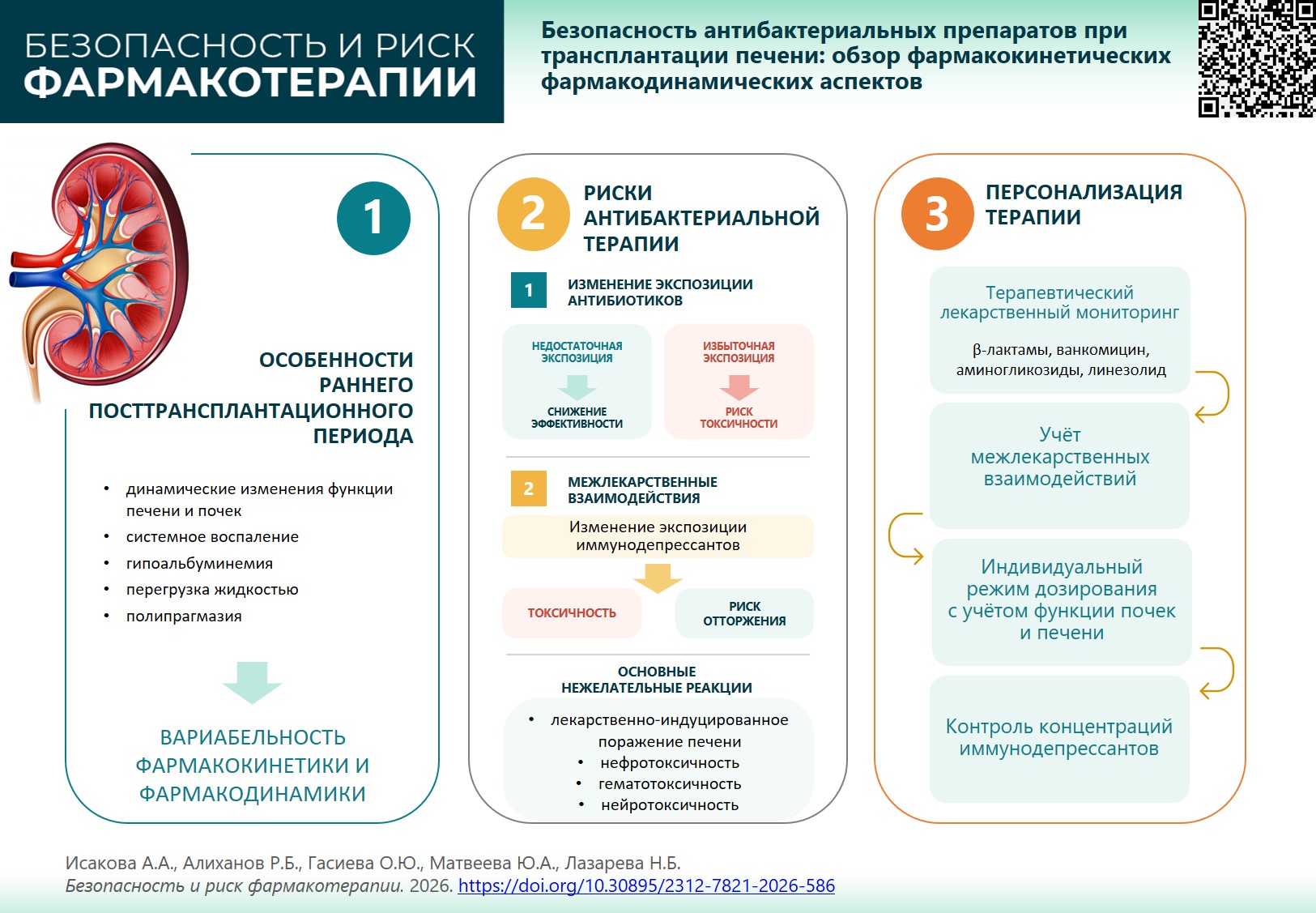
ОБСУЖДЕНИЕ. Анализ данных литературы показал, что частота инфекционных осложнений после трансплантации печени достигает 41,3%, при этом до 21,7% случаев обусловлены полирезистентными штаммами. В раннем посттрансплантационном периоде изменения объема распределения, связывания с белками плазмы крови и клиренса антибактериальных препаратов обусловливают вариабельность системной экспозиции и затрудняют достижение целевых фармакокинетических/фармакодинамических показателей, повышая риск неэффективности и токсичности терапии. Клинически значимые межлекарственные взаимодействия между макролидами (кларитромицин, эритромицин) и ингибиторами кальциневрина (такролимус, циклоспорин), а также ингибиторами мишени рапамицина млекопитающих (сиролимус, эверолимус) сопровождаются повышением концентраций иммунодепрессантов и увеличением риска токсических реакций. Основными нежелательными реакциями являются гепатотоксичность, нефротоксичность, гематологические и неврологические осложнения, риск которых возрастает при полипрагмазии и нарушении функции почек.
ВЫВОДЫ. Фармакокинетическая и фармакодинамическая вариабельность антибактериальных препаратов у реципиентов трансплантата печени определяют необходимость персонализированного подхода. Использование терапевтического лекарственного мониторинга β-лактамных антибиотиков, ванкомицина, аминогликозидов, линезолида и учет межлекарственных взаимодействий может повысить эффективность и безопасность антибактериальной терапии у пациентов после трансплантации печени.
Ключевые слова
трансплантация печени,
антибиотики,
фармакокинетика,
фармакодинамика,
межлекарственные взаимодействия,
безопасность терапии,
β-лактамы,
ванкомицин,
аминогликозиды,
макролиды,
линезолид,
терапевтический лекарственный мониторинг
Финансирование: Работа выполнена без спонсорской поддержки.
Об авторах
А. А. Исакова
Федеральное государственное автономное образовательное учреждение высшего образования «Первый Московский государственный медицинский университет имени И.М. Сеченова» Министерства здравоохранения Российской Федерации (Сеченовский Университет); Государственное бюджетное учреждение здравоохранения города Москвы «Московский клинический научно-практический центр имени А.С. Логинова Департамента здравоохранения города Москвы»
Россия
Россия
Исакова Анастасия Александровна
ул. Трубецкая, д. 8, стр. 2, Москва, 119991;
шоссе Энтузиастов, д. 86, стр. 6, Москва, 111123
Р. Б. Алиханов
Государственное бюджетное учреждение здравоохранения города Москвы «Московский клинический научно-практический центр имени А.С. Логинова Департамента здравоохранения города Москвы»
Россия
Россия
Алиханов Руслан Богданович, д-р мед. наук
шоссе Энтузиастов, д. 86, стр. 6, Москва, 111123
О. Ю. Гасиева
Государственное бюджетное учреждение здравоохранения города Москвы «Московский клинический научно-практический центр имени А.С. Логинова Департамента здравоохранения города Москвы»
Россия
Россия
Гасиева Ольга Юрьевна
шоссе Энтузиастов, д. 86, стр. 6, Москва, 111123
Ю. А. Матвеева
Государственное бюджетное учреждение здравоохранения города Москвы «Московский клинический научно-практический центр имени А.С. Логинова Департамента здравоохранения города Москвы»
Россия
Россия
Матвеева Юлия Александровна
шоссе Энтузиастов, д. 86, стр. 6, Москва, 111123
Н. Б. Лазарева
Федеральное государственное автономное образовательное учреждение высшего образования «Первый Московский государственный медицинский университет имени И.М. Сеченова» Министерства здравоохранения Российской Федерации (Сеченовский Университет)
Россия
Россия
Лазарева Наталья Борисовна, д-р мед. наук, доцент
ул. Трубецкая, д. 8, стр. 2, Москва, 119991
Список литературы
1. Agostini C, Buccianti S, Risaliti M, et al. Complications in post-liver transplant patients. J Clin Med. 2023;12(19):6173. https://doi.org/10.3390/jcm12196173
2. Martin-Mateos R, Martínez-Arenas L, Carvalho-Gomes Á, et al. Multidrug-resistant bacterial infections after liver transplantation: Prevalence, impact, and risk factors. J Hepatol. 2024;80(6):904–12. https://doi.org/10.1016/j.jhep.2024.02.023
3. Боровик ВВ, Тилеубергенов ИИ, Полухина ОВ, Гранов ДА. Инфекционные осложнения как факторы прогноза негативных результатов трансплантации печени. Анналы хирургической гепатологии. 2023;28(3):21–30. https://doi.org/10.16931/1995-5464.2023-3-21-30
4. Taddei R, Riccardi N, Tiseo G, et al. Early intra-abdominal bacterial infections after orthotopic liver transplantation: A narrative review for clinicians. Antibiotics (Basel). 2023;12(8):1316. https://doi.org/10.3390/antibiotics12081316
5. Leibovici-Weissman Y, Anchel N, Nesher E, et al. Early post-liver transplantation infections and their effect on long-term survival. Transpl Infect Dis. 2021;23(4):e13673. https://doi.org/10.1111/tid.13673
6. Guo J, Su Z, Zhong J, et al. Early bacterial pathogen distribution and risk factors for infections after liver transplantation: retrospective cohort study. Int J Infect Dis. 2025;156:107907. https://doi.org/10.1016/j.ijid.2025.107907
7. Buzincu I, Blaj M, Buzincu EI, et al. Early bacterial infections after liver transplantation: Risk factors, microbiological spectrum, and outcomes in an Eastern European cohort. Germs. 2025;15(4):5. https://doi.org/10.3390/germs15040005
8. Lombardi A, Alagna L, Palomba E, et al. New antibiotics against multidrug-resistant gram-negative bacteria in liver transplantation: Clinical perspectives, toxicity, and PK/PD properties. Transpl Int. 2024;37:11692. https://doi.org/10.3389/ti.2024.11692
9. Hao Q, Wang H, Zhang Q, et al. Risk factors for multidrug-resistant bacterial infections after liver transplantation. Ann Transplant. 2025;30:e949047. https://doi.org/10.12659/AOT.949047
10. Morales Junior R, Telles JP, Kwiatkowski SYC, et al. Pharmacokinetic and pharmacodynamic considerations of antibiotics and antifungals in liver transplantation recipients. Liver Transpl. 2023;29(1):91–102. https://doi.org/10.1002/lt.26517
11. Liu H, Man K. New insights in mechanisms and therapeutics for short- and long-term impacts of hepatic ischemia reperfusion injury post liver transplantation. Int J Mol Sci. 2021;22(15):8210. https://doi.org/10.3390/ijms22158210
12. Chiu KW, Nakano T, Chen KD, et al. Cytochrome P450 in living donor liver transplantation. J Biomed Sci. 2015;22(1):32. https://doi.org/10.1186/s12929-015-0140-4
13. Rampes S, Ma D. Hepatic ischemia-reperfusion injury in liver transplant setting: Mechanisms and protective strategies. J Biomed Res. 2019;33(6):395–419. https://doi.org/10.7555/JBR.33.20190016
14. Li M, Zhao Y, Humar A, et al. Pharmacokinetics of drugs in adult living donor liver transplant patients: Regulatory factors and observations based on studies in animals and humans. Expert Opin Drug Metab Toxicol. 2016;12(3):231–43. https://doi.org/10.1517/17425255.2016.1139575
15. El Hajj Abdallah Y, Chahal S, Jamali F, et al. Drug–disease interaction: Clinical consequences of inflammation on drug action and disposition. J Pharm Pharm Sci. 2023;26:11137. https://doi.org/10.3389/jpps.2023.11137
16. Сушков АИ, Рудаков ВС, Попов МВ и др. Функция почек у реципиентов печени: углубленный анализ данных Локального научного регистра трансплантаций Федерального медицинского биофизического центра им. А.И. Бурназяна. Трансплантология. 2025;17(2):138–56. https://doi.org/10.23873/2074-0506-2025-17-2-138-156
17. Lewis SJ, Mueller BA. Antibiotic dosing in patients with acute kidney injury: “Enough but not too much”. J Intensive Care Med. 2016;31(3):164–76. https://doi.org/10.1177/0885066614555490
18. Smibert OC, Vogrin S, Sinclair M, et al. Antibiotic exposure and risk of allograft rejection and survival after liver transplant: An observational cohort study from a tertiary referral centre. Transpl Infect Dis. 2025;27(3):e70026. https://doi.org/10.1111/tid.70026
19. Shah S, Barton G, Fischer A. Pharmacokinetic considerations and dosing strategies of antibiotics in the critically ill patient. J Intensive Care Soc. 2015;16(2):147–53. https://doi.org/10.1177/1751143714564816
20. Amaral B, Vicente M, Pereira CSM, et al. Approach to the liver transplant early postoperative period: An institutional standpoint. Rev Bras Ter Intensiva. 2019;31(4):561–70. https://doi.org/10.5935/0103-507X.20190076
21. Bratlid D, Bergan T. Displacement of albumin-bound antimicrobial agents by bilirubin. Pharmacology. 1976;14(5):464–72. https://doi.org/10.1159/000136629
22. Bhagat V, Pandit RA, Ambapurkar S, Sengar M, et al. Drug interactions between antimicrobial and immunosuppressive agents in solid organ transplant recipients. Indian J Crit Care Med. 2021;25(1):67–76. https://doi.org/10.5005/jp-journals-10071-23439
23. Sparkes T, Lemonovich TL, AST Infectious Diseases Community of Practice. Interactions between anti-infective agents and immunosuppressants — Guidelines from the American Society of Transplantation Infectious Diseases Community of Practice. Clin Transplant. 2019;33(9):e13510. https://doi.org/10.1111/ctr.13510
24. Magro B, Tacelli M, Mazzola A, et al. Biliary complications after liver transplantation: current perspectives and future strategies. Hepatobiliary Surg Nutr. 2021;10(1):76–92. https://doi.org/10.21037/hbsn.2019.09.01
25. Ulldemolins M, Roberts JA, Rello J, et al. The effects of hypoalbuminaemia on optimizing antibacterial dosing in critically ill patients. Clin Pharmacokinet. 2011;50(2):99–110. https://doi.org/10.2165/11539220-000000000-00000
26. Shoji K, Saito J, Nakagawa H, et al. Population pharmacokinetics and dosing optimization of vancomycin in pediatric liver transplant recipients. Microbiol Spectr. 2021;9(2):e0046021. https://doi.org/10.1128/Spectrum.00460-21
27. Veiga RP, Paiva JA. Pharmacokinetics–pharmacodynamics issues relevant for the clinical use of beta-lactam antibiotics in critically ill patients. Crit Care. 2018;22(1):233. https://doi.org/10.1186/s13054-018-2155-1
28. Gatti M, Pea F. Pharmacokinetic/pharmacodynamic issues for optimizing treatment with beta-lactams of Gram-negative infections in critically ill orthotopic liver transplant recipients: A comprehensive review. Front Antibiot. 2024;3:1426753. https://doi.org/10.3389/frabi.2024.1426753
29. Gatti M, Rinaldi M, Laici C, et al. Role of a real-time TDM-based expert clinical pharmacological advice program in optimizing early pharmacokinetic/pharmacodynamic target attainment of continuous infusion beta-lactams among orthotopic liver transplant recipients with Gram-negative infections. Antibiotics (Basel). 2023;12(11):1599. https://doi.org/10.3390/antibiotics12111599
30. Azadi SA, Jalali SS, Mohammadi-Samani S, et al. Therapeutic vancomycin monitoring: A comparative analysis of high-performance liquid chromatography and chemiluminescent microparticle immunoassay methods in liver transplant recipients. Front Pharmacol. 2025;16:1516339. https://doi.org/10.3389/fphar.2025.1516339
31. Heffernan AJ, Lim SMS, Lipman J, Roberts JA. A personalised approach to antibiotic pharmacokinetics and pharmacodynamics in critically ill patients. Anaesth Crit Care Pain Med. 2021;40(6):100970. https://doi.org/10.1016/j.accpm.2021.100970
32. Shi X, Yang W, Zhao F, et al. Population pharmacokinetics and thrombocytopenia risk assessment of linezolid in liver transplant recipients. J Antimicrob Chemother. 2025;80(7):1915–25. https://doi.org/10.1093/jac/dkaf147
33. European Association for the Study of the Liver. EASL Clinical Practice Guidelines on liver transplantation. J Hepatol. 2024;81(6):1040–86. https://doi.org/10.1016/j.jhep.2024.07.032
34. Monostory K. Metabolic drug interactions with immunosuppressants. In: Tsoulfas G, ed. Organ donation and transplantation — Current status and future challenges. London: IntechOpen; 2018. https://doi.org/10.5772/intechopen.74524
35. Wolf U. A drug safety briefing (II) in transplantation from real-world individual pharmacotherapy management to prevent patient and graft from polypharmacy risks at the very earliest stage. Pharmaceuticals (Basel). 2024;17(3):294. https://doi.org/10.3390/ph17030294
36. Page RL, Ruscin JM, Fish D, LaPointe M. Possible interaction between intravenous azithromycin and oral cyclosporine. Pharmacotherapy. 2001;21(11):1436–43. https://doi.org/10.1592/phco.21.17.1436.34434
37. Bolhuis MS, Panday PN, Pranger AD, et al. Pharmacokinetic drug interactions of antimicrobial drugs: A systematic review on oxazolidinones, rifamycines, macrolides, fluoroquinolones, and beta-lactams. Pharmaceutics. 2011;3(4):865–913. https://doi.org/10.3390/pharmaceutics3040865
38. Van Matre ET, Satyanarayana G, Page RL, et al. Pharmacokinetic drug–drug interactions between immunosuppressant and antiinfective agents: Antimetabolites and corticosteroids. Ann Transplant. 2018;23:66–74. https://doi.org/10.12659/aot.906164
39. Rodríguez AT, Font I Barceló A, Barrantes González M, et al. Clinically important pharmacokinetic drug–drug interactions with antibacterial agents. Rev Esp Quimioter. 2024;37(4):299–322. https://doi.org/10.37201/req/037.2024
40. Jiménez-Pérez M, González-Grande R, García-Cortés M, et al. Drug-induced liver injury after liver transplantation. Liver Transpl. 2020;26(9):1167–76. https://doi.org/10.1002/lt.25804
41. Sembera S, Lammert C, Talwalkar JA, et al. Frequency, clinical presentation, and outcomes of drug-induced liver injury after liver transplantation. Liver Transpl. 2012;18(7):803–10. https://doi.org/10.1002/lt.23424
42. Ma J, Björnsson ES, Chalasani N. Hepatotoxicity of antibiotics and antifungals and their safe use in hepatic impairment. Semin Liver Dis. 2024;44(2):239–57. https://doi.org/10.1055/s-0044-1787062
43. Termeer A, Hoitsma AJ, Koene RA. Severe nephrotoxicity caused by the combined use of gentamicin and cyclosporine in renal allograft recipients. Transplantation. 1986;42(2):220–1. PMID: 3526659
44. Kim JY, Yee J, Yoon HY, et al. Risk factors for vancomycin-associated acute kidney injury: A systematic review and meta-analysis. Br J Clin Pharmacol. 2022;88(9):3977–89. https://doi.org/10.1111/bcp.15429
45. Roger C, Louart B. Beta-lactams toxicity in the intensive care unit: An underestimated collateral damage? Microorganisms. 2021;9(7):1505. https://doi.org/10.3390/microorganisms9071505
46. Alshehri AM, Al Yami MS, Aldairem A, et al. Evaluating the risk of acute kidney injury and mortality associated with concomitant use of vancomycin with piperacillin/tazobactam or meropenem in critically ill and non-critically ill patients: A systematic review and meta-analysis. BMC Infect Dis. 2025;25(1):36. https://doi.org/10.1186/s12879-024-10227-0
47. Wei R, Li K, Wang H, Zhang Y. Using machine learning to predict linezolid-associated thrombocytopenia. Infect Drug Resist. 2025;18:2653–61. https://doi.org/10.2147/IDR.S479658
48. Matsumoto K, Shigemi A, Takeshita A, et al. Analysis of thrombocytopenic effects and population pharmacokinetics of linezolid: A dosage strategy according to the trough concentration target and renal function in adult patients. Int J Antimicrob Agents. 2014;44(3):242–7. https://doi.org/10.1016/j.ijantimicag.2014.05.010
49. Beumier M, Casu GS, Hites M, et al. Elevated β-lactam concentrations are associated with neurological deterioration in ICU septic patients. Minerva Anestesiol. 2015;81(5):497–506. PMID: 25220556
50. Gatti M, Raschi E, De Ponti F. Serious adverse events with novel beta-lactam/beta-lactamase inhibitor combinations: A largescale pharmacovigilance analysis. Eur J Clin Microbiol Infect Dis. 2021;40(6):1169–76. https://doi.org/10.1007/s10096-020-04149-3
51. Abdul-Aziz MH, Alffenaar JC, Bassetti M, et al. Antimicrobial therapeutic drug monitoring in critically ill adult patients: A Position Paper. Intensive Care Med. 2020;46(6):1127–53. https://doi.org/10.1007/s00134-020-06050-1
52. Rybak MJ, Le J, Lodise TP, et al. Therapeutic monitoring of vancomycin for serious methicillin-resistant Staphylococcus aureus infections: A revised consensus guideline and review by the American Society of Health-System Pharmacists, the Infectious Diseases Society of America, the Pediatric Infectious Diseases Society, and the Society of Infectious Diseases Pharmacists. Am J Health Syst Pharm. 2020;77(11):835–64. https://doi.org/10.1093/ajhp/zxaa036
Дополнительные файлы

|
1. Таблица S1. Основные виды межлекарственного взаимодействия антибактериальных препаратов с лекарственными средствами, используемыми в качестве иммуносупрессивной терапии у реципиентов трансплантации печени | |
| Тема | ||
| Тип | Исследовательские инструменты | |
Скачать
(230KB)
|
Метаданные ▾ | |
Рецензия
Для цитирования:
Исакова А.А., Алиханов Р.Б., Гасиева О.Ю., Матвеева Ю.А., Лазарева Н.Б. Безопасность антибактериальных препаратов при трансплантации печени: обзор фармакокинетических фармакодинамических аспектов. Безопасность и риск фармакотерапии. 2026. https://doi.org/10.30895/2312-7821-2026-586
For citation:
Isakova A.A., Alikhanov R.B., Gasieva O.Yu., Matveeva J.A., Lazareva N.B. Safety of Antibacterial Agents in Liver Transplantation: A Review of Pharmacokinetic and Pharmacodynamic Aspects. Safety and Risk of Pharmacotherapy. 2026. (In Russ.) https://doi.org/10.30895/2312-7821-2026-586
Просмотров:
45
JATS XML





 Послать статью по эл. почте